
A grant case is assembled out of a literature review, a dataset, a model configuration, a partner institution and an ethics approval, each of which lives somewhere else and belongs to somebody else. Nobody ever sees the whole thing at once, which is how a methods section ends up citing one framework while the data was collected under another. Lay it out in one piece and that becomes obvious in an afternoon rather than in a rejection letter.
The literature is in a reference manager, with your actual opinion of half of it in the margins of a PDF. The data is on a share, and some of it is at the partner institution and always has been. The model configuration is in a repository, or in a folder whose name ends in a number. The ethics approval is an attachment on an email from 2022. The methods section is in a document written last week, citing something you read carefully in 2019.
None of that is disorganised, only that a grant case has never had a surface to sit on, so it exists as six correct things in six places and as one argument only inside the head of whoever is writing it. Which makes the reviewer the first person ever to read the case whole, and they’re reading it to find what is wrong with it.
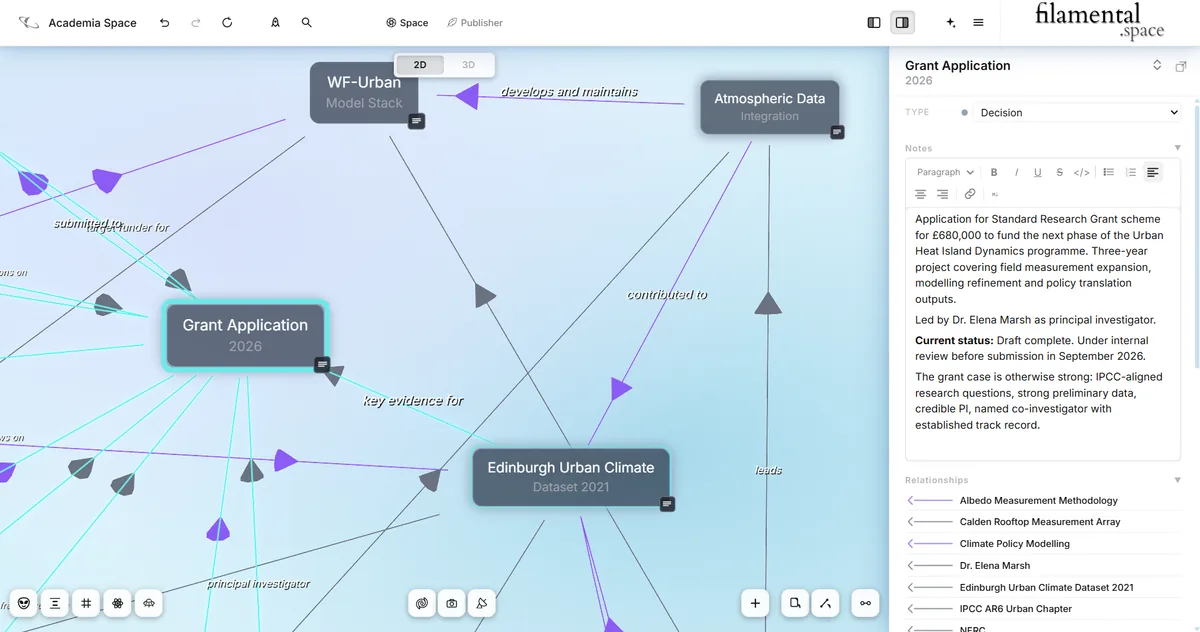
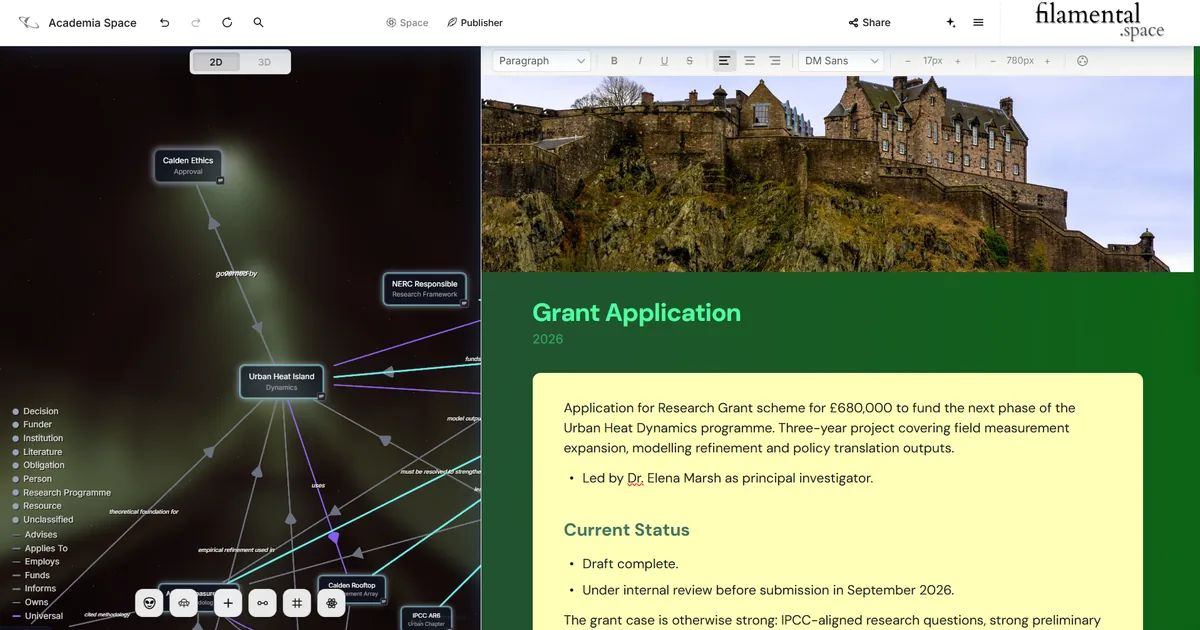
Every research question, claim, source, dataset, method, collaborator, obligation and output becomes a node, and the lines between them are typed and named by you: supports, contradicts, uses, collected under, depends on. That isn’t a filing system but the argument, drawn.
The useful consequence is that a framework cited in your methods section and a protocol used to collect your data are the same node, not two mentions in two documents. When they disagree, the disagreement is a visible line rather than a fact that happens to be true in two files nobody reads together. Contradiction becomes a relationship you can draw on purpose, which is the one thing a folder structure fundamentally can’t represent.
The notes carry the part with nowhere else to live: why this method rather than the obvious alternative, what the preliminary data doesn’t yet show, which reviewer objection you’re anticipating and how you plan to answer it. None of that belongs in a paper and all of it is what you actually need in September.
A small interdisciplinary institute, three weeks from submitting a three-year bid worth several hundred thousand pounds. The case is strong on paper: research questions aligned to the field's priorities, real preliminary data, a credible principal investigator and a named co-investigator at a partner university whose involvement is much of why the application is competitive at all.
The methods section describes the measurement framework the literature review is built on. The preliminary dataset, collected two summers earlier with the partner's group, was processed under a different one. The numerical model uses the second framework's parameterisation as well. Neither of those two choices was ever formally recorded, because each was made in passing by a different person during a different phase of work, which is how almost every methodological decision gets made.
A reviewer with expertise in that measurement area finds it in the first pass, and reads it as either an error or an oversight. The group's previous application was turned down on methodological grounds. The inconsistency was found because somebody laid the case out as a structure, and it took an afternoon. It wasn’t going to be found by reading the draft again, because it isn’t visible in the draft.
It doesn’t want your library, your PDFs, your statistics, your transcripts or your figures. Your reference manager stays where it is, your analysis stays in whatever you analyse in, and your writing stays in whatever you write in. Nothing is imported and nothing is migrated. It reads a folder on your own machine, with no account, no sign-in and no telemetry, so there’s no processor to name in a data management plan and no transfer to declare.
And it’s plain text. Every node is a Markdown file with a few lines of structured data at the top, readable in any editor, depositable alongside your data, and entirely legible if this software stops existing. Research outlasts the tools it was done in, which is a lesson your field learns roughly once a decade, and it’s the reason there’s no database here holding anything hostage.
It won’t format your bibliography, run your statistics or write your paper, and it isn’t trying to. Keep whatever does those. This is for the thinking in between, which is the part nobody has ever sold you software for.
Research groups lose their reasoning constantly and treat it as weather. The student who built the pipeline submits and leaves. The postdoc who chose the parameterisation moves institution. The technician who knows why that site was dropped from the sampling frame retires. What remains is the outputs, which record what was concluded and almost never why, and the next person spends their first six months rediscovering decisions rather than making new ones.
Writing the reason next to the thing is a small habit that pays back at exactly the moments that matter: a bid, an audit, a successor arriving, a reviewer asking why. And when somebody outside needs to follow it, a co-investigator at another institution, a supervisor, a panel or an industrial partner, a space can be sent as a link or a single file that opens in an ordinary browser with the structure navigable inside it. They install nothing, create no account and pay nothing, which is the only version of sharing that actually works across institutional boundaries.
You don’t begin with a blank screen. A Template is a starting vocabulary, the kinds of thing that exist in a job and the ways they relate, so the categories are already there and already coloured when you make a space.
A starting point, not a schema you’re stuck inside. Rename a category, add one, delete the ones you never use. Nothing stops you using more than one in a space. Research Literature and Research to Publication are the two next door most often reached for, and clinical groups tend to want Clinical Trials alongside these.
Everything above except the sending is on the free plan, permanently, with no account and no card. There’s no academic tier, no institutional agreement and no eligibility form, because there’s nothing to be eligible for. For most researchers the real cost of new software isn’t the money, it’s the six weeks of approvals, and on the free plan there’s no purchase, no account and no data leaving the machine to approve.
Spaces are unlimited and the bridges joining them are free, so a research programme becomes a few linked spaces rather than one unreadable one: the literature in the first, the methods and data in the second, the bid and its obligations in the third, each one click from the others. Each holds twenty nodes, which is about the size at which an argument is still legible.
The paid tier is $120 a year, or $12 a month, and buys exactly one thing: handing a space to somebody who doesn’t have Filamental. For most researchers that is a co-investigator, a supervisor or a panel, and if you never need to do it, you never need to pay.
No. Keep it. A reference manager holds the papers, the metadata and the citation keys, and it does that well. What it can’t hold is what a paper is doing in your argument: which claim it supports, which finding it contradicts, and which of your own decisions was made on the strength of it. Filamental sits above the library rather than against it, so a source becomes a node carrying your reading of it, and the PDF stays where it already lives.
It’s a desktop application that reads a folder on your own machine, with no account, no sign-in and no telemetry of any kind. Nothing is uploaded and nothing is collected, so there’s no processor to name and no transfer to disclose. Whatever your data management plan already says about files on your institutional laptop applies unchanged, and it works with no network connection at all.
For the free plan there’s nothing to approve in the usual sense: no account is created, no institutional sign-on is involved, no data leaves the device and there’s no purchase. It installs like any other desktop application, and on a managed machine that’s the only question your IT team is likely to have. Local policy still governs what you may install, so check that rather than assuming.
Yes. Publisher turns a space into a document you send as a link or a single HTML file, and it opens in an ordinary browser with the structure navigable inside it. Your collaborator installs nothing, creates no account and pays nothing, which matters when they are at a different institution with different software rules. One published link at a time is free, and the paid tier, at $120 a year or $12 a month, adds more links, updates to a link already sent, the HTML download and presenting.
They’re Markdown files with YAML frontmatter in an ordinary folder, which is to say plain text. They open in any editor on any operating system, they can be deposited in a repository alongside data, and they survive this software disappearing entirely. That’s a deliberate design decision rather than an export feature, and it’s the reason there’s no database holding your work hostage.
The Personal plan is free permanently, with no account and no card, and everything involved in building and reading a research structure is on it. There’s no academic license to apply for because there’s nothing to apply for. The paid tier is $120 a year, or $12 a month, and buys one thing: sending a space to somebody who doesn’t have Filamental, which for most researchers means a co-investigator, a supervisor or a panel.
One case and an afternoon is enough to find out whether this suits how you think. Free, no account, no card, and nothing that leaves your machine.