Publisher Studio

Everything you build survives the handover

Send a link or a single file. It opens in an ordinary browser with nothing to install, and what arrives is the structure itself, still navigable, not a picture of where it used to be.

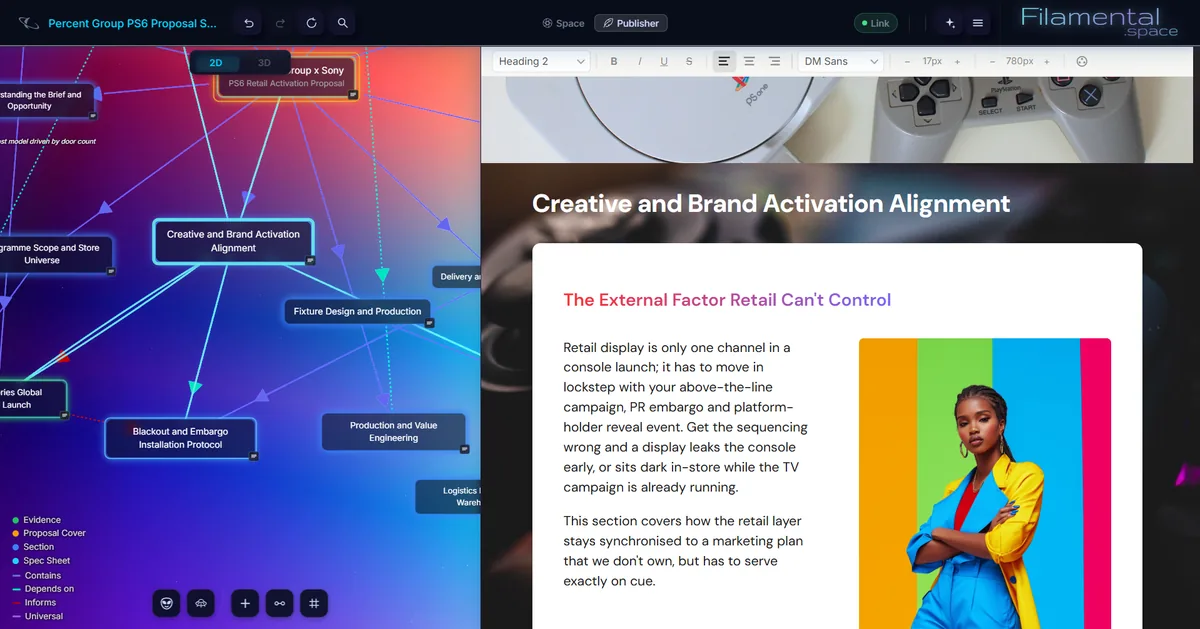
The document, and its own map The structure on the left is the contents page. Its connectors read Contains, Depends on and Informs, which is more than a chapter number can say.
A client proposal open in Publisher Studio. On the left the document's own structure is drawn as a map, with sections such as Creative and Brand Activation Alignment and Blackout and Embargo Installation Protocol joined by connectors labelled Contains, Depends on and Informs. On the right the same section renders as a finished page with a cover photograph, headings and a two-column layout.
At the other end

The contents page they experience

Almost every way of sending work to somebody involves pressing it flat first. A report becomes a PDF, a structure becomes a picture, and the contextual arrangement that was doing half the explaining does not make the trip.

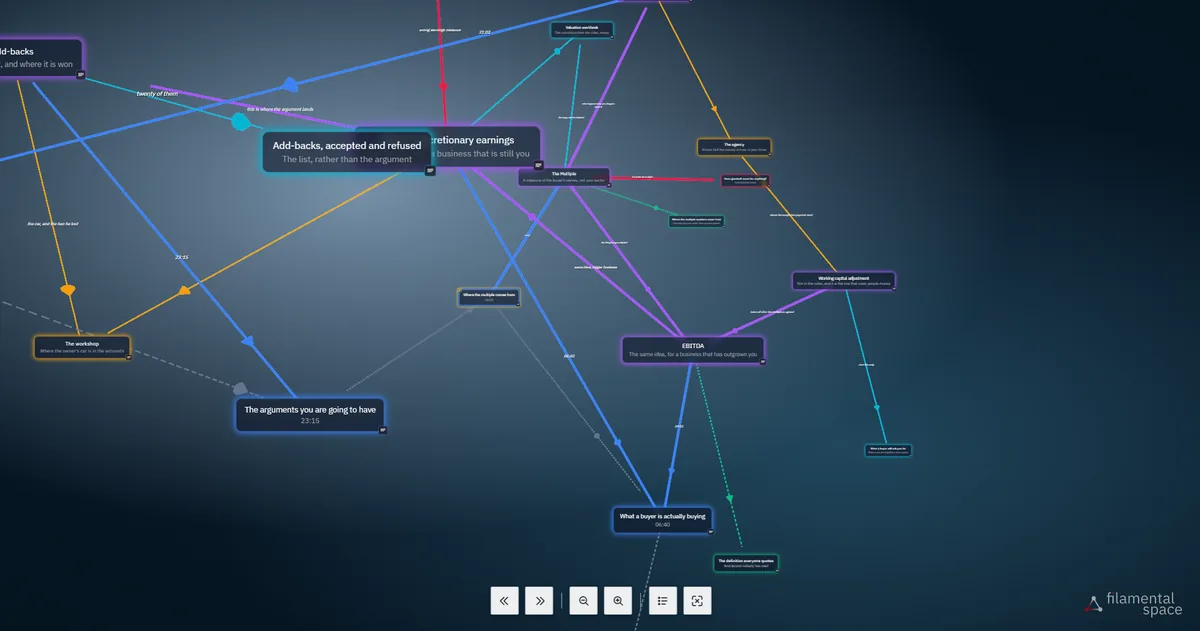
What arrives here is the shape itself. Your reader turns it, zooms into a section, taps a node and the page opens. They can read the whole thing in the order you intended, or go straight to the part they were looking for and see immediately what it hangs off.

It is read-only, so nothing they do disturbs your copy, and it works as well on a phone as on a laptop. There is also nothing for them to install, no account to make and nothing to subscribe to.

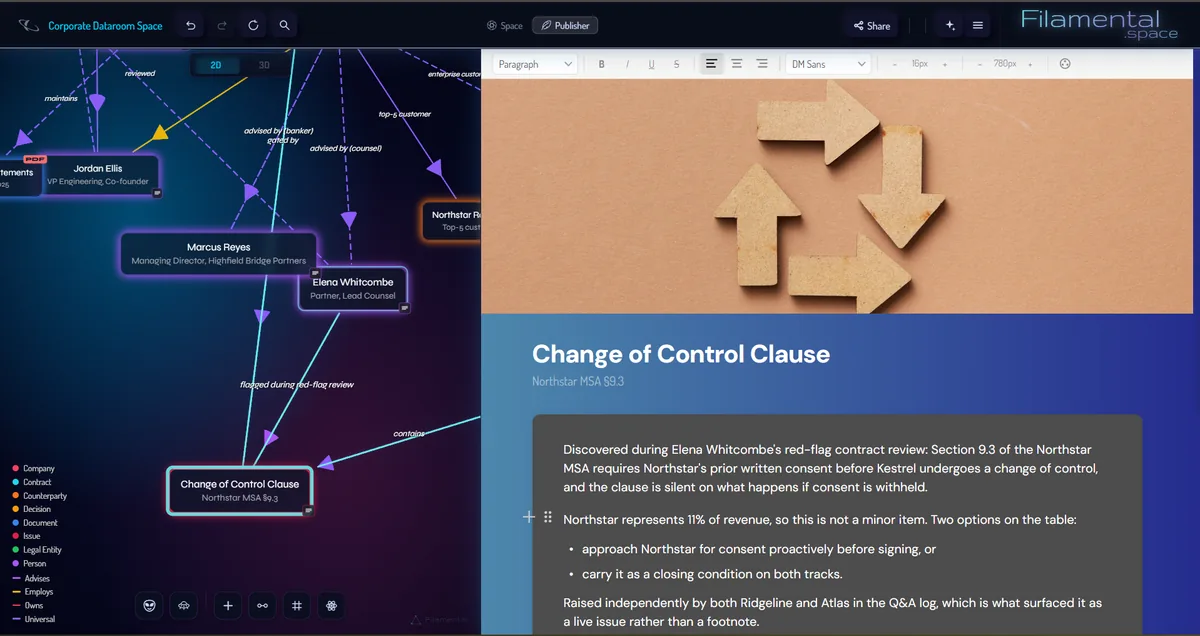
One node, both ways at once The Change of Control clause selected in the graph on the left and published on the right. A single set of files sits under both halves.
One node shown two ways at once. The left half is the graph, with the Change of Control Clause node selected among the people and documents it connects to, and a legend naming each type and connector. The right half is the same node as a published page, with a cover image, its heading and subheading over a blue gradient, and the same notes set as body copy and a bulleted list.
What you hand over

A link, or a single file that is yours outright

Both are made from a snapshot of the space as it stands when you press the button. Pick whichever suits the person waiting for it.

An encrypted link

Send a link the way you would send anything

Paste it into an email, a message or a ticket. It opens in a browser on a phone as readily as on a desktop, and the person opening it has nothing to set up.

  • Push an update to the same link whenever the work moves on.
  • Revoke it at any time and it stops resolving.
  • Add an optional password if the link itself might travel further than you intended.

Expires by itself after 180 days, so nothing you shared last year is still quietly available.

One HTML file

No infrastructure involved, including ours

The whole thing, in a single file. Attach it, archive it, put it on a memory stick and post it. It opens in any browser with nothing running behind it.

  • Works offline, and keeps working.
  • Nothing to expire, because there is no server in the picture.
  • Attachments travel inside it rather than being left behind.

This is genuinely yours. No servers anywhere, it carries on working indefinitely.

Who this is for

You can build an entire document in just the Publisher and never need to touch a node type

The Publisher Studio does not require you to have used the construction surface (Space Studio) first, or at all. Plenty of people never do.

Just use it like a traditional document creator.

Make pages, give them cover images and proper long-form formatting, connect to other pages, arrange them so that related things sit near each other. The arrangement becomes the contents page your reader navigates.
Nothing here asks you to define a vocabulary of types or think about a graph as a graph.

If that describes you, the 3D/2D structure is simply how your document is organised. And if you also work in Space Studio concurrently, it is the same either way. Switching between them is a toggle, not a save and an export, because it's still the same structure underneath.

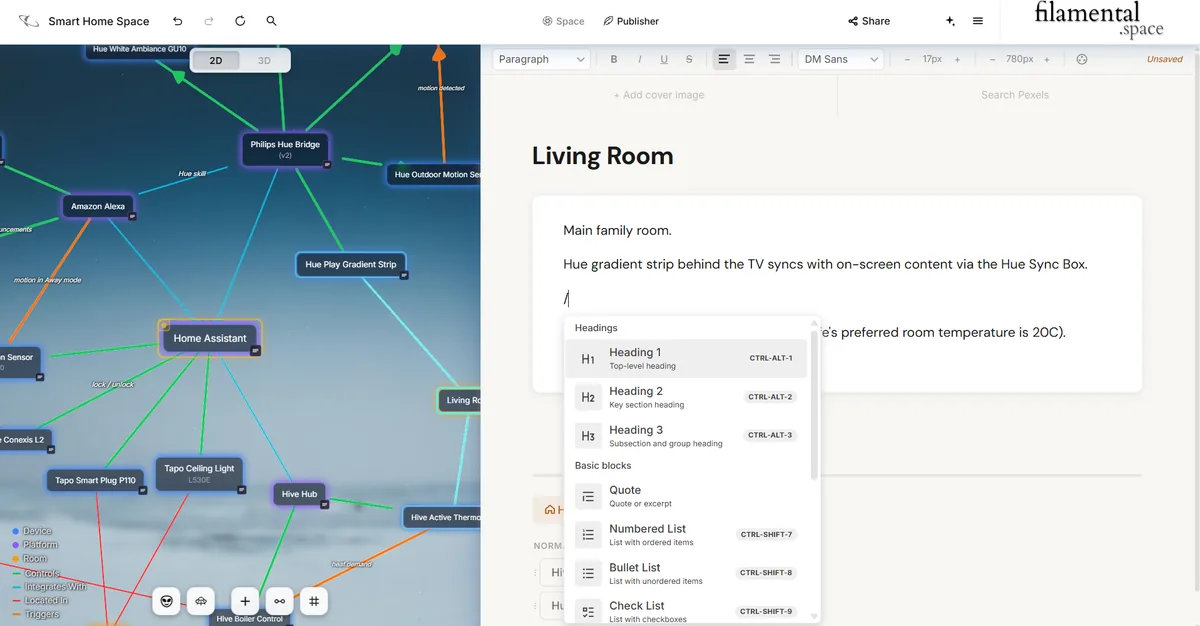
Type a slash Headings, quotes, lists and checklists, with their shortcuts beside them. This is the whole of what you have to learn to write a page.
A page being written in Publisher with a slash typed into the body and the block menu open beneath it. The menu is grouped, with Headings offering Heading 1, 2 and 3 against their keyboard shortcuts, and Basic blocks offering Quote, Numbered List, Bullet List and Check List. The page itself is a room in a smart home space, and the graph beside it shows the hub, the bridge, the lights and the sensors joined by connectors named Controls, Integrates With, Located In and Triggers.

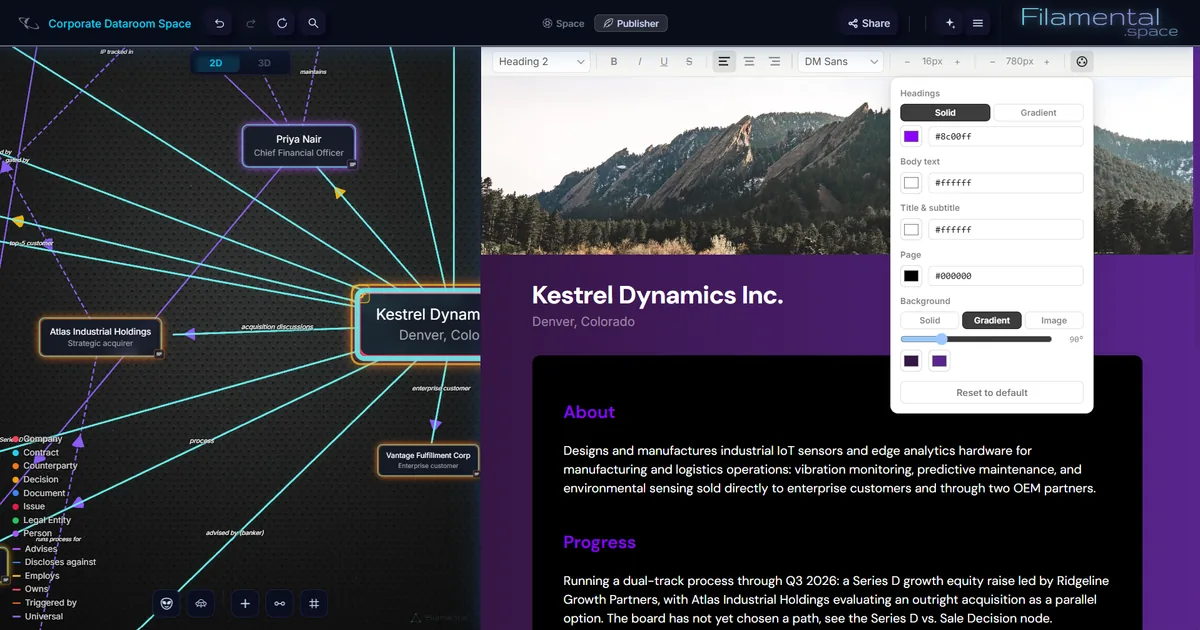
Colour is set the same way, and per document rather than per app. Headings, body text, the title, the page and its background are five separate choices, and the background can be a flat colour, a gradient, or an image.

Colour, set part by part Headings, body, title, page and background each take their own value, and the background here is a two-stop gradient rather than a flat fill.
Publisher open on a corporate dataroom space with the colour controls showing. The panel sets Headings, Body text, Title and subtitle, Page and Background independently, each with its own hex field, and the background is set to a two-stop gradient at ninety degrees rather than a flat colour. Behind the panel the page it is styling carries a mountain photograph as its cover, a purple ground, magenta headings reading About and Progress, and body copy describing an industrial sensor manufacturer and a dual-track process.
What we can see

Nothing. That is the entire answer

Snapshots are encrypted on your own machine before they go anywhere. What reaches us is ciphertext, and it stays that way while we hold it. We cannot read a shared space, whether or not you set a password on it, and there is no setting that changes that because it is not a setting.

The password, if you use one, is a separate control doing a different job: it decides who gets in once they have the link. The encryption is not optional, never was and never will be.

We do not want your data. It belongs to you, not to us. Publishing exists because people asked to send their work to colleagues and clients who do not use Filamental, and the whole feature was designed around us never holding anything readable from the outset.

Out loud, before you send one

Three things worth knowing

  1. It is a snapshot, not a live feed

    What you send is the space as it was at that moment. When you are ready for them to see the new version, you update it and it is pushed to the same link.

  2. A hosted link lasts 180 days

    Then it expires on its own. Too many confidential documents have been discovered because they accumulated somewhere indefinitely. If you need something more permanent, consider exporting as a file instead (no expiry).

  3. A link outlives your Professional trial

    If you publish during your first fifteen days and then move to the free plan, the link keeps working for its full 180 days. You lose the ability to push updates to it but you keep the ability to revoke it if you need to. We won't leave you stranded.

What it costs

One payment a year, and what they received stays received

Publishing is the paid part of Filamental. Everything involved in building a structure/project is free and will always stay free; publishing is the part that leaves your computer, and it is what the money is for. One price, no upselling.

Publishing your work anywhere else generally means renting access to your work back, and your work is gone when you stop paying rent. That is one way to run a service but it should also be called what it is... hosting with bells on. It is a different business from ours, we believe in sovereignty and ownership. We don't monetise the data we didn't create.

Send one this week

The first fifteen days include all of this

No card, no account, nothing to cancel. Build something, publish it, and watch somebody open it. It won't be your best creation, but you will enjoy the experience.

Version
0.3.36
Platforms
Win / macOS / Linux
Personal
Free, permanent
Professional
$120 / year