
A campaign across a dozen markets runs on workstreams that all touch each other: production lead times, kitting and freight, installer bookings, retailer approvals, creative sign-off, digital integration, support cover, and an estate that has to survive three years after launch. Every one of them is written down somewhere. What is written down nowhere is how they depend on each other, which is the only thing you actually need the moment something moves.
The proposal that won the work. A schedule in a planning tool. A creative deck. A compliance matrix per retailer. An SLA appendix. A wiki page somebody started in March. Each one is true about its own slice, and not one of them holds the shape.
So the reveal slips a fortnight, or a market drops out, or a retailer changes its fixture policy, and working out what that touches becomes a job for whoever has been there longest. The whole campaign is the one artefact nobody is keeping, and it’s the one everybody keeps asking for.
Build the campaign once as connected parts. A workstream, a fixture spec, a market, a retailer's compliance profile, a risk, a support tier, the precedent that proves you can do the thing you said you could. Each part is a file with its own notes and its own attachments, written by whoever owns it.
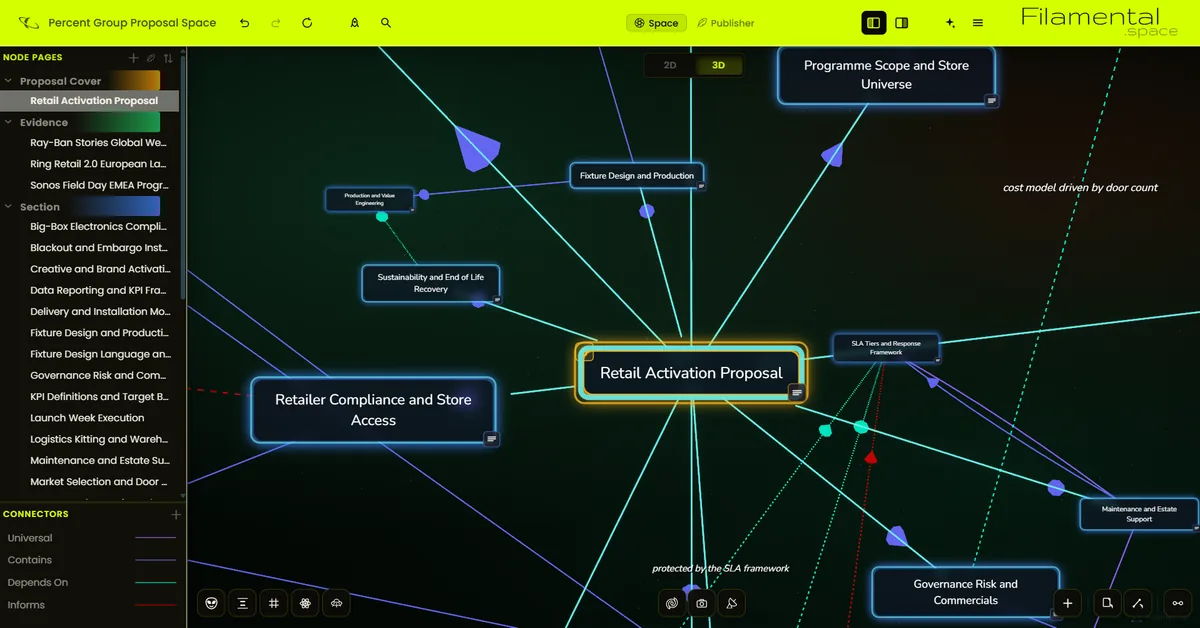
The connection is where the work happens. An install window depends on a retailer approval. A support tier depends on the digital integration going live. A flagship build depends on a production lead time that depends on a tooling decision taken months earlier. Those are real objects with names of their own, not lines on a slide, so what does this touch becomes something you follow rather than something you convene about.
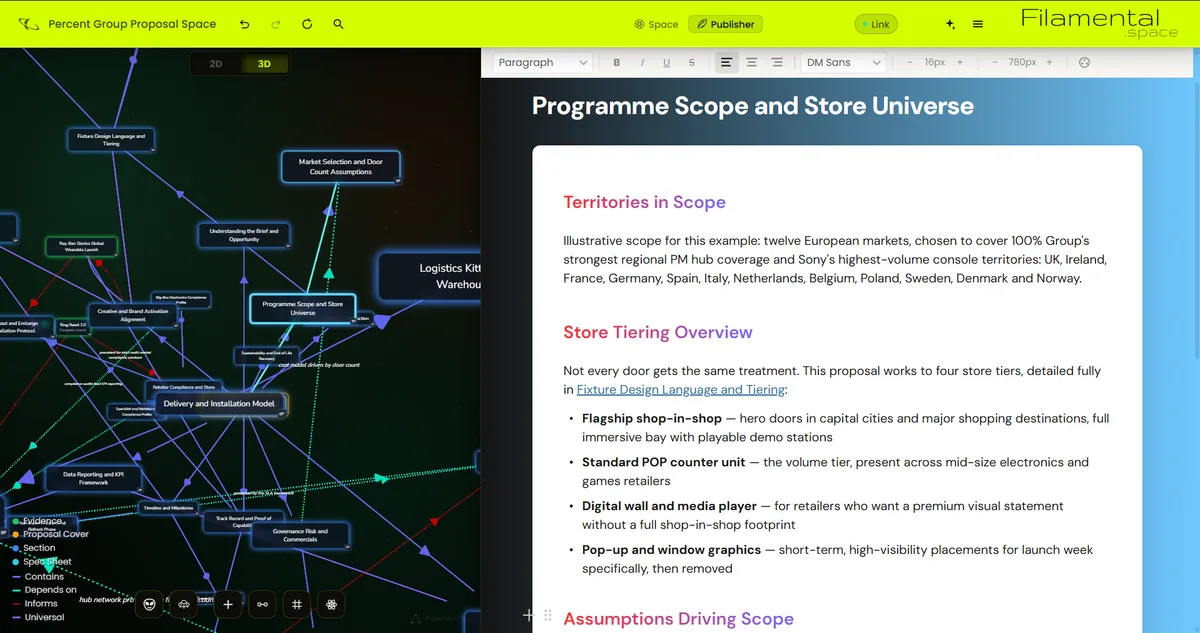
And that one structure is already three documents. Publisher lays it out as the proposal you send. The dependencies are the plan. The notes accumulating on each part are the reference the next person reads. Nobody has to keep three artefacts in step, because there aren’t three artefacts.
A console launch across twelve European markets: roughly 2,400 doors in four store tiers, from flagship shop-in-shop bays down to counter units and window graphics, with an estate that has to stay on brand for three years rather than a fortnight. Thirty-three connected parts. The agency and the client are both constructed for the example, as are the numbers.
Follow one thread. The reveal is a single synchronised moment, so fixtures go in under privacy covers during the embargo and the covers come off everywhere at once. Flagship bays need two to three days on site each, which is why they are installed first. That makes the embargo window the real constraint on the whole install programme, and a covered fixture standing on a shop floor is itself a named leak risk in the register.
Now move the reveal two weeks earlier. That compresses the embargo window, which is where the longest installs sit, which pushes flagship stores into a shorter run at exactly the tier where store-specific problems take longest to resolve, which raises the number of days a covered fixture waits in public. Four consequences, none of them in the same document, and every one of them a connection you can walk.
The same structure answers the neighbouring questions the same way: which markets a supplier delay reaches, which claims in the proposal have a precedent behind them and which are assertions, and what the support obligation looks like in year three once the launch team has moved on.
No Gantt chart, no task assignment, no dates that recalculate when one slips, no resource levelling and no notifications. Whatever you run execution in, keep it. This holds the campaign's shape rather than its status, and they’re genuinely different artefacts: the status tells you a date moved, the shape tells you what that costs.
What it is instead: a folder on your own machine. Plain text files you could open in Notepad, attachments left as the original files in their original formats, no account, no sign-in, no sync client and no server it needs to reach. There’s no telemetry in the application at all, none, which for anyone sitting on an unannounced launch date is the part that actually matters. An embargoed product name never leaves the machine it was typed on unless you send it deliberately.
A campaign is judged and approved by people who will never open your software: the client's marketing lead, a brand guardian who cares about two pages of it, procurement who cares about a different two, a finance director who reads the commercials and nothing else, and a regional team who only need their own market.
A space can be sent as a link or as a single file that opens in an ordinary browser. Each of those readers goes straight to their own part, and the evidence sits one click behind the claim it supports rather than forty pages away in an appendix. They install nothing, pay nothing and have no account.
A snapshot is encrypted on your own machine before it goes anywhere, so what reaches us is ciphertext and stays that way. We can’t read it, and there’s no setting that changes that because it isn’t a setting. A password, if you add one, is a separate control over who gets in once they have the link. A hosted link expires by itself after 180 days and can be revoked at any time before that.
The same shape solves the quieter problem of somebody senior moving on and taking the reasoning behind a campaign with them. Here it was written down as the work happened, because writing it down was how the campaign got built.
A space is plain Markdown files in a folder, so anything that can read files can read the entire campaign, dependencies included. There is also an MCP server for a live connection to the space you have open, which the assistants people actually use already speak.
That matters because of what comes next. An assistant holding your ClickUp or Jira connector can read the workstreams and build the task tree from them, draft KPI definitions off the reporting section, or turn the milestone chain into whatever view your team lives in. It isn’t inferring structure from a PDF and guessing at the dependencies, because the dependencies were written as real connections when the campaign was built.
It goes back the other way too. Given write access it can put status onto the part it belongs to, so what actually happened accrues on the same structure that planned it, rather than in a separate report that has quietly disagreed with the plan since week six.
Filamental integrates with nothing, and that’s the design rather than an apology. No ClickUp connector here, no Jira connector, no webhook, and no outbound request made on your behalf. The integration belongs to your assistant, which means it works with whatever you already use and keeps working when you change it.
You don’t begin with a blank screen. A Template is a starting vocabulary, the kinds of thing that exist in a job and the ways they relate, so the categories are already there and already coloured when you make a space.
Supplier Network and Resource & Dependency ship too, and nothing stops you using more than one in a space. A starting point, not a schema you’re stuck inside: rename a category, add one, delete the ones you never use.
Everything described up to the point of sending is on the free plan: no account, no card, no trial running out and no capability quietly withheld. Attachments aren’t limited and never will be, and neither is any of the AI side of it.
A campaign this size won’t fit in one space, and it isn’t supposed to. Spaces are unlimited, each holds twenty nodes, and the bridges between them are free and don’t count against that. So the programme sits in one, the market and retailer detail in another, the spec sheets in a third and the precedent library in a fourth, joined and navigable as one thing. That distribution is the useful shape anyway, because a workstream owner opens their own space rather than scrolling through everybody else's.
The paid tier is $120 a year, or $12 a month, and it buys exactly one thing: sending a space to somebody who doesn’t have Filamental. If the proposal, the client readout or the board update is a deliverable rather than a nicety, you’ll want it. Worth saying plainly here rather than leaving you to discover it on the day it goes out.
No, and it doesn’t try to. Those track execution: which doors are installed, which are late, who is on site on Thursday. Filamental has no Gantt chart, no task assignment, no dates that recalculate and no notifications. It holds the shape of the campaign rather than its status, which is the artefact that decides what a slipped date actually costs. Keep running delivery wherever you run it now.
No. Filamental has no integrations at all, with anything, and makes no outbound request on your behalf. What it has instead is a format your assistant already reads: a space is plain Markdown files in a folder, plus an MCP server for a live connection to the one you have open. So an AI assistant that already holds your ClickUp or Jira connector can read the campaign structure with its dependencies intact and build the task tree itself. The integration is your assistant's, not ours, which also means it works with whichever tools you happen to use.
Yes, as a link or as a single HTML file that opens in an ordinary browser. The client installs nothing, pays nothing and needs no account, and they get the structure rather than a flattened document, so a spec sheet behind an appendix and the case study behind a claim are one click away instead of forty pages away. A snapshot is encrypted on your own machine before it goes anywhere, so what we hold is ciphertext and we can’t read it whether or not you set a password. Links expire by themselves after 180 days and can be revoked at any time.
In a folder on your own machine, and nowhere else. There’s no account, no sign-in, no sync client and no server the application needs to reach, and there’s no telemetry in it at all. For anyone holding an embargoed product name or an unannounced launch date, that’s the part that matters: it never leaves the machine it was typed on unless you deliberately send it. It also means no vendor questionnaire and no security review before you can start.
It’s a folder of plain files, so it lives wherever your team already keeps shared files and everyone opens the same one. What it doesn’t do is real-time co-editing: there’s no live sync and no presence, so two people typing into the same part at the same moment isn’t a supported thing. In practice one person owns the structure while everyone contributes to their own workstream, which is usually how a campaign of this size runs anyway.
Building and keeping the structure costs nothing. The Personal plan is free permanently with no account and no card, and it covers unlimited spaces with free bridges between them, which is the shape a multi-workstream campaign wants anyway. The paid tier is $120 a year, or $12 a month, with no per-seat ladder and no per-campaign fee, and it buys one thing: handing a space to somebody who doesn’t have Filamental. If the proposal or the client readout is a deliverable, you’ll want it.
Pick the one that goes wrong every time. Put in what it waits on and what waits on it, and you’ll have written down the thing that until now has only ever been understood. Free, no account, no card, and nothing to cancel if it turns out it doesn’t suit you.