
A pre-commencement condition with a seasonal survey window. A drawdown that unlocks only on evidence of start on site. A contribution that falls due on first occupation, indexed from a date in 2024. None of it is on a programme, because none of it has a date yet, and all of it is load-bearing. This is where you keep what you have signed, alongside what each one blocks.
The council holds the conditions. The lender holds the drawdown schedule and the facility expiry. The solicitor holds the agreement and the trigger buried in it. The contractor holds the mobilisation window. The agent holds the reservations, and one of the buyers has a scheme approval that has gone quiet. Each of those parties is competent and each of them can see precisely one column of the scheme.
The joins between them exist nowhere but in your head, and the joins are what the scheme actually runs on. You don’t lose money on the thing you were worrying about. You lose it on the one that was three moves away from it.
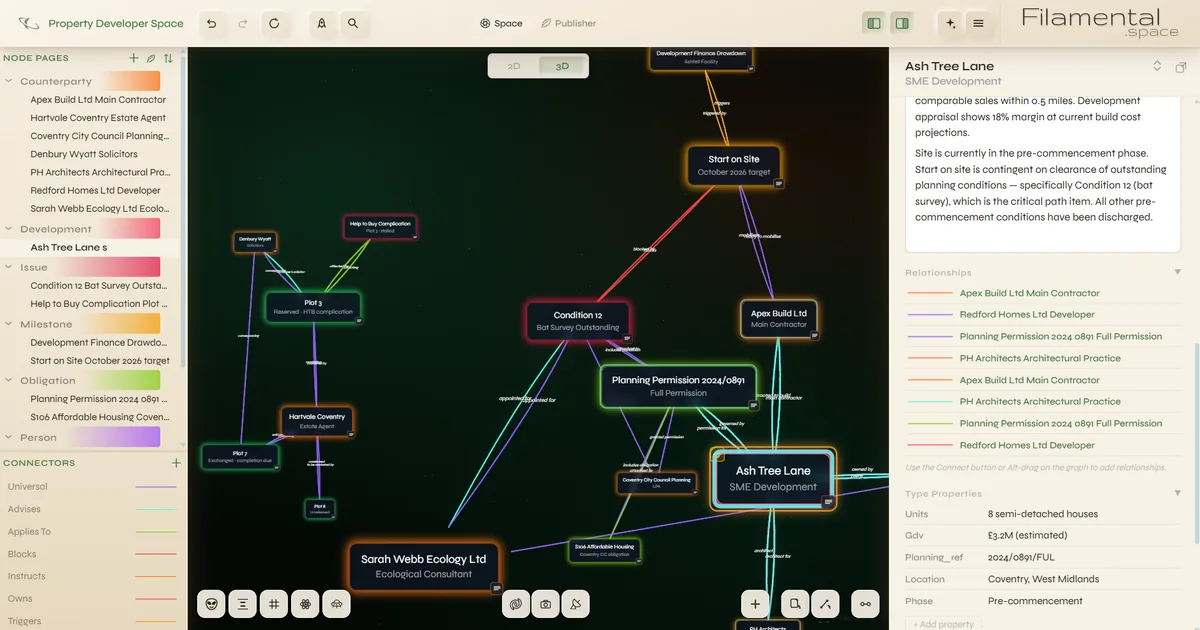
Every plot, permission, condition, obligation, contract, facility, consultant and counterparty is a node. The lines between them are typed and directional, named by you: blocks, triggers, discharged by, secured against, bound by. So the ecology condition doesn’t sit in a folder of decision notices. It sits attached to the start date it’s blocking, which is attached to the first drawdown it releases, which is attached to the facility whose expiry sets the end of everything.
That’s the difference between recording an obligation and holding one. A calendar can’t carry a payment that falls due on first occupation, because first occupation isn’t a date, it’s an event that hasn’t happened. Drawn as a relationship it’s permanent, visible, and attached to the thing that will cause it, so it surfaces the moment you look at the plot rather than three weeks after somebody moves in.
Then the ordinary part. Drag the decision notice onto the permission, the ecology report onto the condition it discharges, the facility letter onto the loan and the reservation form onto the plot. Click any of them and it opens in whatever normally opens it. Nothing is converted, and the folder underneath is still a folder.
A small residential scheme, eight units, permission granted and everything apparently on track for an October start. One pre-commencement condition is outstanding: an ecology survey, required because there’s a Victorian outbuilding on the plot with features suitable for roosting. The consultant is appointed and booked. Nothing about this looks like the problem on the site.
Then the chain. That survey can only be carried out inside the active season, roughly May to September. The results go to the authority for approval, which takes six to eight weeks to determine. Nothing at all may start on site until the condition is formally discharged, which means no demolition, no groundworks, not even stripping topsoil. The contractor is holding programme capacity but can’t mobilise, and needs four weeks once cleared.
Two more hops and it stops being a planning matter. Start on site is what evidences the first drawdown on the development facility, so the money doesn’t move either. Miss the window and the next viable survey season is the spring, which is a full season lost on land carrying finance at a shade under one per cent a month, against a facility that expires at the end of the following year and would then need the lender's agreement to extend. One protected species, four hops, and the entire commercial shape of the scheme.
It doesn’t calculate a critical path, level resources, assign tasks, chase anybody or produce a programme. It won’t tell you what today's priority is. Those are real jobs and there’s real software for them, most of it built for schemes considerably larger than yours, and none of it is what this is.
What it is, is a folder on your own machine. No account, no sign-in, no portal, no seat licenses and no telemetry, so nothing about a scheme, a lender or a buyer leaves the device it’s on. Notes are plain text files and attachments are the actual files, which means you can open the folder in Explorer and it looks like a folder, because it’s one. It also works with no signal at all, which is the ordinary condition of a site cabin.
It won’t do your valuations, your CIS returns or your health and safety file either, and isn’t trying to. Keep whatever does. This is for the layer above them, which is currently your memory.
Your solicitor works in a case management system. Your contractor works in a programme. Your lender's monitoring surveyor works to a certificate. Your agent works in a property portal. None of them will adopt your software and it would be strange to ask, so any tool that only pays off when everybody uses it is a tool that doesn’t pay off here.
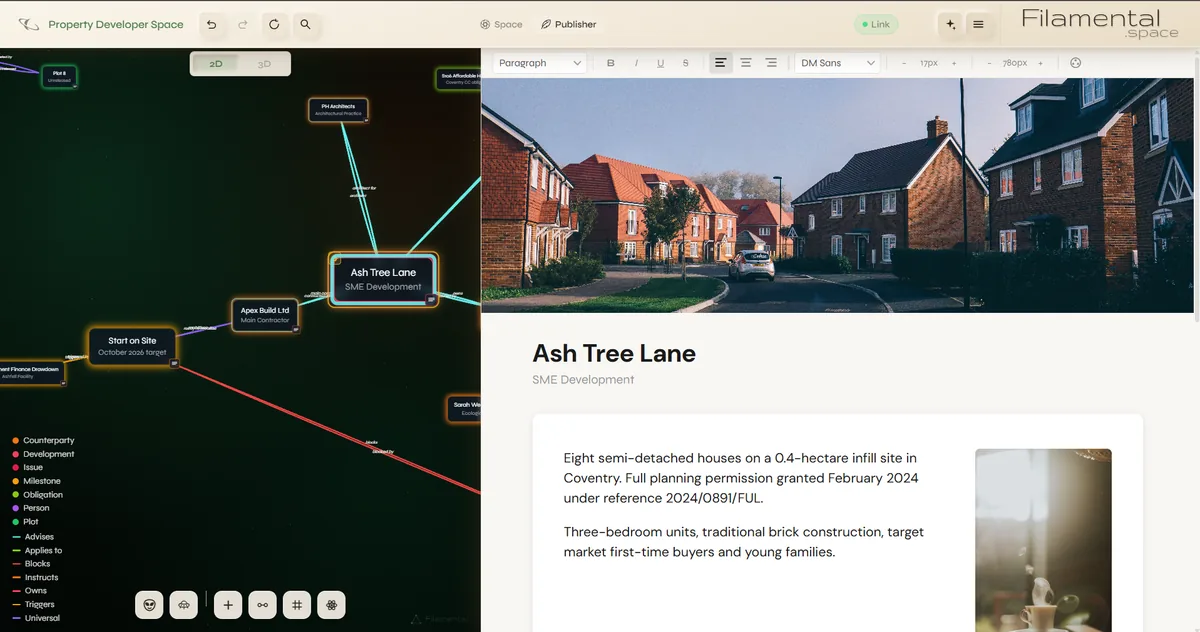
This one is the opposite: one person holds the structure, and the moment somebody needs to see it, the space goes out as a link or a single file that opens in an ordinary browser with the whole thing navigable inside it and the documents attached where they belong. The lender asking why the start has moved and what it does to the drawdown schedule gets an answer they can read rather than a phone call and a promise. The same document is what an incoming partner, a buying agent or your own successor would need, and it’s the version of the scheme that doesn’t walk out of the door with you.
You don’t begin with a blank screen. A Template is a starting vocabulary, the kinds of thing that exist in a job and the ways they relate, so the categories are already there and already coloured when you make a space.
A starting point, not a schema you’re stuck inside. Rename a category, add one, delete the ones you never use. There’s no Template named after development specifically, and Contract & Obligation is the one most schemes end up living in. Nothing stops you using more than one in a space.
Everything above except the sending is on the free plan, permanently, with no account and no card. Nothing is priced per project, per site or per user, which is the model most software in this category uses and the reason a two-site developer ends up running the whole thing off a shared drive and a memory.
Spaces are unlimited and the bridges joining them are free, so each site becomes its own space with one for the company beside it: this scheme in the first, the next one in the second, the company, its facilities and its professional team in the third, each one click from the others. Each holds twenty nodes, which for a scheme of this size is roughly the conditions, the plots and the parties.
The paid tier is $120 a year, or $12 a month, and buys exactly one thing: handing a space to somebody who doesn’t have Filamental. On a scheme that’s the lender, the solicitor and eventually a buyer's advisers, and it pays for itself the first time a written answer replaces a week of correspondence.
No. It has no Gantt chart, no critical path calculation, no resource levelling and no task assignment, and it won’t tell anybody what to do today. It holds what exists on a scheme and what each thing blocks or triggers, which is the layer above the programme rather than the programme itself. If you run a build programme in dedicated software, keep it.
Yes. Drag any file onto the thing it concerns and it attaches there, as many as you like, alongside whatever notes you have written. The decision notice sits on the permission, the ecology report sits on the condition it discharges, the facility letter sits on the loan. Click one and it opens in whatever normally opens it. Nothing is converted and nothing is trapped in a format only we can read.
No, and on most schemes only one person ever installs it. Your contractor, solicitor, agent, architect and lender all work in their own systems and won’t adopt yours. Publisher turns the space into a document you send as a link or a single HTML file that opens in an ordinary browser, so they read it without installing anything, creating an account or paying anything.
A folder holds documents and knows nothing about what they do. It can’t tell you that a pre-commencement condition blocks the start date, that the start date triggers the first drawdown, or that a clause signed two years ago fires on first occupation. Here those are drawn relationships, so opening the condition shows you everything downstream of it, and the cost of a slip is visible rather than something you work out in your head at two in the morning.
Neither. It’s a desktop application for Windows, macOS and Linux that reads files on your own disk. There’s no account, no sign-in and no telemetry of any kind, so it works the same in a site cabin with one bar of signal as it does in the office, and commercially sensitive detail about a scheme never leaves the machine it’s on.
The Personal plan is free permanently, with no account and no card, and there’s no per-project or per-site fee, which is the pricing model this category usually reaches for. Spaces are unlimited and the bridges joining them are free, so each site becomes its own space alongside one for the company. Each holds twenty nodes. The paid tier is $120 a year, or $12 a month, and buys sending a space to somebody who doesn’t have Filamental.
One scheme and an evening is enough to find out whether this suits how you work. Free, no account, no card, and nothing to cancel if it turns out it doesn’t.