
Two weeks in, you hold a working model of how the client’s business actually operates, and twelve weeks later you leave and the model leaves with you. The deck records what you decided, and this is where the thing you decided it from can live, in a form the client still has next year.
Interviews, a partial system rollout, four spreadsheets, an out-of-date org chart and one person who genuinely understands how the operation runs. Out of that you assemble a better picture of the business than the client has, in a fortnight, because systems thinking is the job and you’ve done it before.
Then it lives in your head and in the margins of a notebook until the engagement ends. What gets delivered is forty slides of conclusions. The client keeps the answer and loses the reasoning, which is why they’ll pay somebody to build the same model again in eighteen months.
Every site, asset, contract, supplier, system and constraint becomes a node, and the lines between them are typed and named by you: supplies, depends on, constrains, works around.
The layout is generated from the connections rather than arranged by you, so the structure of the business is what you’re looking at. A single point of failure is the node everything routes through. Key-person risk is a person with six things attached to them. Findings you’d reach by intuition in week six are sitting there in week two, in a form you can show somebody, and the client’s inevitable question, what does this actually touch, is one click.
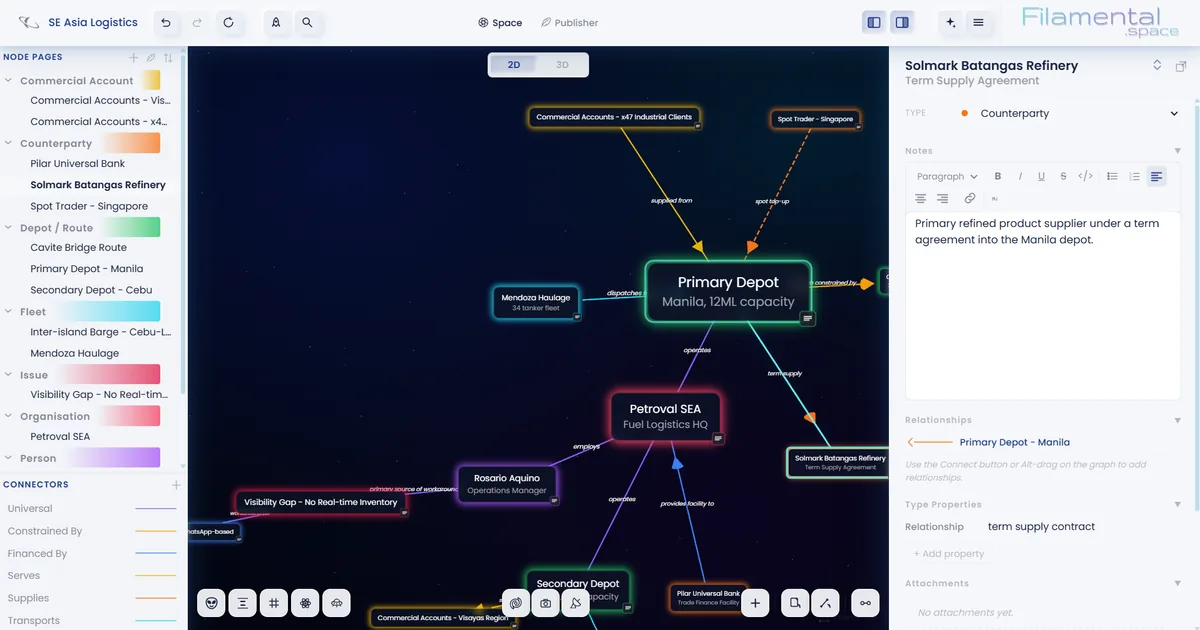
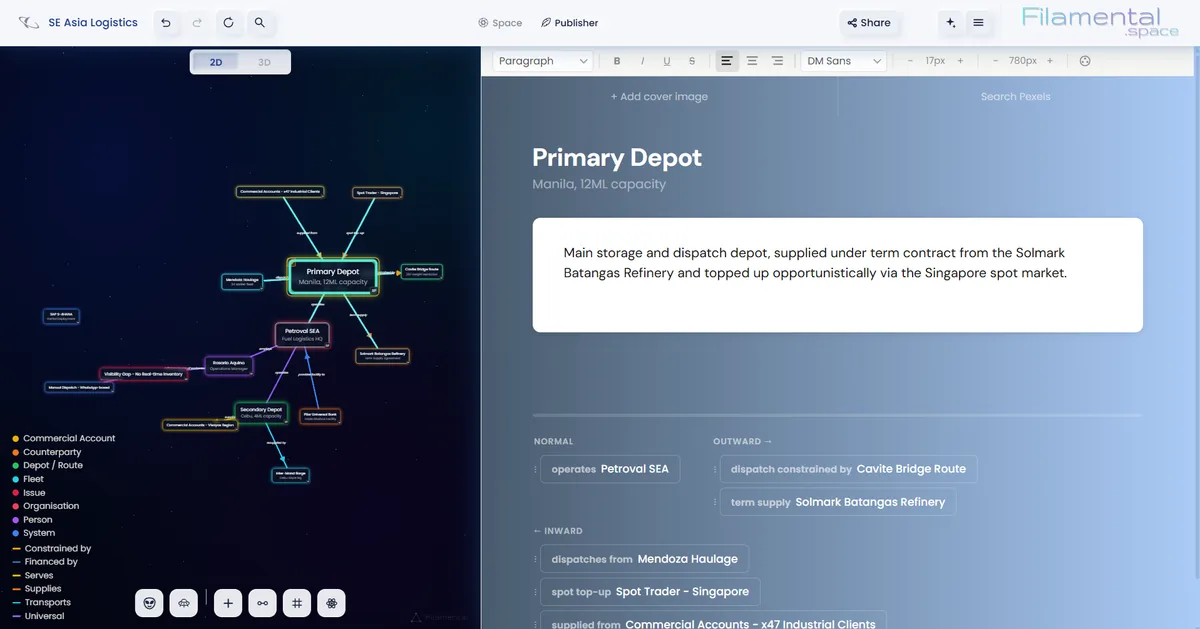
A fuel distributor operating across an archipelago: a main depot and a smaller regional one, a contracted tanker fleet, an inter-island barge leg, industrial accounts and a forecourt network. On paper it’s a stock control problem, and the brief was written that way.
Laid out, three things sit adjacent for the first time: the enterprise system stopped short of depot inventory and dispatch, the regional depot is resupplied by exactly one barge leg, and a weight restriction on the bridge out of the main depot means a misjudged dispatch costs a full re-route.
The node they all connect to isn’t a system but the operations manager, because the real-time picture of which tankers are where and which depot is running low exists in her head and in a group chat. The finding isn’t that the business needs inventory software but that its early-warning function is one person, and it’s unavailable the day she is.
There’s no integration to scope, no credentials to request and no security review to sit through, so you build the model from what you’re told and shown, three weeks earlier than an integration would let you.
It’s a desktop app reading a folder on your own machine, with no account, no cloud storage and no telemetry, so there’s no sub-processor to disclose: if your laptop is inside the NDA, so is this.
Keep whatever you build slides in, because this won’t do that. This is for the model behind them.
At the end of the engagement the space goes out as a link or a single file that opens in an ordinary browser, with the reasoning attached where it belongs, and it still opens in three years when the person who commissioned you has moved on.
A deck is evidence that you thought, while a model is the thinking itself, and it makes the follow-on engagement a continuation rather than a rebuild. On your side, the structure you refine over three engagements in the same sector becomes the thing you start engagement four from.
A Template is a starting vocabulary, so the categories arrive named when you make a space.
There’s no Template called Consulting, because consulting is a job done to somebody else’s domain. Start from whichever one matches the client: Supplier Network for an operations brief, System Component Map for a technology one.
Most people who read this site never need the paid tier, and we say so on their pages. You’re the exception, because handing the structure to somebody who doesn’t have Filamental is your deliverable rather than a convenience.
It’s one plan, not per client or per engagement. Set against a day rate it’s a rounding error on a single engagement.
Building the model is free permanently, with no account and no card, and each client is its own space, kept separate, which is what your obligations require anyway.
Yes, and it’s the reason most consultants pay for this. Publisher turns a space into a document you send as a link or a single HTML file, and it opens in an ordinary browser with the structure navigable inside it. The client installs nothing, creates no account and pays nothing, and they can still open it in three years. You can also simply hand over the folder itself, since it’s Markdown files and belongs to whoever holds it.
No, and on this kind of work that’s a feature rather than a limitation. There’s no integration to scope, no credentials to request, no security review to sit through and no data processing agreement to negotiate before you can start thinking. You build the model from what you are told and what you read, which is what you were doing anyway, three weeks earlier than an integration would have let you.
That it’s a desktop application reading files on your own machine, with no account, no sign-in, no cloud storage and no telemetry of any kind. Nothing is uploaded and nothing is collected, so there’s no sub-processor to disclose and nothing to add to an engagement letter. If your laptop is already covered by the NDA, so is this.
Yes. More than sixty Templates ship with the application, each one a starting vocabulary of the things that exist in a kind of work and the ways they relate, and you can edit any of them or build your own. Since a space is just a folder, your own house structure is a folder you copy at the start of an engagement, which is how most people end up working after the second one.
A diagram is a picture you draw and then maintain by hand, and it stops being true the week the engagement moves on. Here the structure is the data: nodes carry notes, properties and attachments, relationships are typed and walkable in both directions, and the layout is generated rather than positioned by you. It’s closer to a model you can interrogate than to a drawing you have to keep accurate.
Building and reading a structure is free permanently, with no account and no card. The paid tier isn’t per client or per engagement, and it buys the one thing this audience actually wants: handing a space to somebody who doesn’t have Filamental, or presenting it to them. Unlike most readers of this site, you probably will pay, and it’s likely to be the smallest line on any engagement you run.
One engagement is enough to find out whether this suits how you work. Free to build in, no account, no card, and nothing that leaves your machine.