
Where others see movement, you see the forces behind it, and you’re usually the one who writes the list everybody else follows. Filamental gives the system somewhere to live before it becomes that list.
Systems thinking is an old idea. Engineers and management writers have used the phrase for decades to mean looking at a situation as parts, connections and the pressure each one puts on the others, rather than as a list of separate tasks.
What’s new is where the phrase turns up. It appears more and more in job descriptions for product, operations and design roles, usually as a line asking for someone who can see how the pieces fit. As AI takes on more of the tasks, the person who understands the system those tasks sit in becomes the one a team can’t do without.
You probably don’t need a job description to tell you which one you are.
Most of the tools you’re handed are built for the output: the document, the slide, the spreadsheet, the ticket. Each one holds a slice, and the structure connecting them stays in your head, which is where it does the least good.
So you become the person everybody asks. What breaks if this supplier is late, who signs off on that change, why the report everyone uses depends on a field nobody maintains. You know, because you’re carrying the whole map, and the map has no copy.
The hard part is never the thinking, but the sheer size of what you’re holding.
In a Filamental space, each part of the system is a node, and every node is a full document with room for the reasoning behind it. Connectors join them and carry a type, a direction and a label, so a line says feeds, reports to or funds and points the way the relationship runs.
Dark Energy is our auto-arrange, and it lays the structure out by its connections, so the shape you see comes from what’s joined to what rather than the order you happened to enter it in. The Lens, in the left panel, lights one kind of thing (every risk, every supplier, every place the money goes) and lets the rest recede behind it without hiding any of it. Pathfinder takes two nodes and names every stop between them.
There’s no centre and no hierarchy you have to start from, so a system with five ways in can keep all five.
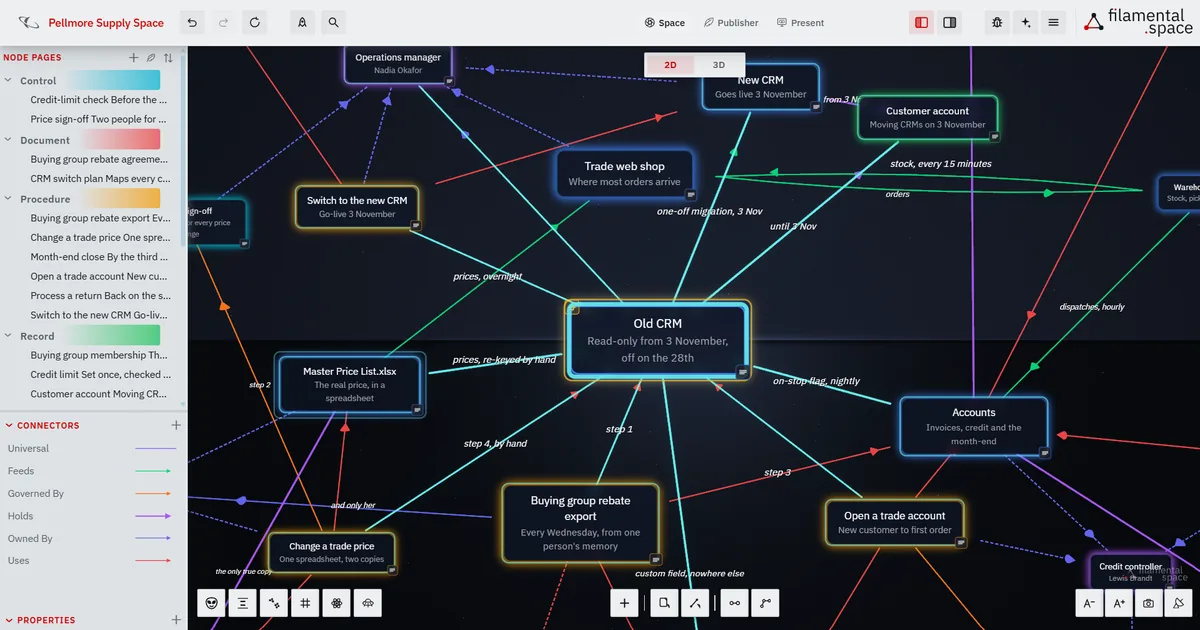
A space goes out as a link or a single file that opens in an ordinary browser, with the documents attached and nothing to install. The person reading it doesn’t need your vocabulary or half an hour of your time, because the structure is on the surface.
The map has a copy at last, and you stop being the only place it’s kept.
An AI can read a folder of documents and draft a first structure from it. Deciding what matters, what depends on what and where the pressure sits is still the systems thinker’s call, and a space is where you make it.
Connect your own AI and it reads the space as you’ve drawn it, with typed parts, named relationships and the direction each one runs, all written into plain files on your own machine. Ask it how two things are connected and it reads the route back, stop by stop. See how AI works with Filamental.
Someone who looks at a situation and sees its parts, how they connect and what pushes on what, before seeing the individual tasks. The idea comes from engineering and management writing going back decades, and the phrase now turns up more often in job descriptions, usually as a request for someone who can see how the pieces fit together.
No. There’s no notation to learn and no method to follow. You put the parts down, connect them and say why, and Filamental lays the structure out from the connections you’ve drawn. If you already have a method you like, a space holds it in whatever classifications and connector types you define.
You can draw a loop, since connectors carry a direction and any node can connect to any other, so a reinforcing or balancing loop is a few connections. Filamental doesn’t run the numbers, though, so there are no stocks, flows or simulations over time. For that a modelling tool is the right one, and a space is a good place to lay the system out before you model it and to explain it once you have.
A mind map grows out from one centre, and everything in it is a branch of that centre. A space has no centre, so any part can connect to any other, and each connection has a type and a direction of its own. Filamental lays it out in three dimensions, which gives a dense system room before it tangles.
No account, no card, for as long as you like. Point Filamental at a folder or start with an empty space, and lay out the thing you’ve been carrying in your head.