
Two weeks in, you hold a working model of how the client's business actually operates, and it’s the most valuable thing you’ll produce. Twelve weeks later you present conclusions drawn from it, and then you leave, and the model leaves with you. The deck records what you decided. This is where the thing you decided it from can live, in a form the client still has next year.
Interviews, a partial system rollout, four spreadsheets, an org chart eighteen months out of date, and one person who genuinely understands how the operation runs. Out of that you assemble a picture of the business that is better than anything the client has, and you do it in a fortnight because you have done it before.
Then it lives in your head and in the margins of a notebook until the engagement ends. What gets delivered is forty slides of conclusions. The client keeps the answer and loses the reasoning, which is why they will pay somebody to build the same model again in eighteen months.
Every site, asset, contract, supplier, customer segment, system and constraint becomes a node, and the lines between them are typed and named by you: supplies, depends on, constrains, works around, financed by. That much is just careful note-taking with the relationships written down instead of implied.
What you get back is the part you can’t get from a list. The layout is generated from the connections rather than arranged by you, so the structure of the business is what you are looking at rather than your own tidiness. A single point of failure is the node everything routes through. Key-person risk is a person with six things attached to them. A constraint that turns out to be the whole answer is the small node with an unreasonable number of lines coming out of it. Findings you would otherwise reach by intuition in week six are sitting there in week two, in a form you can show somebody.
And because the relationships are walkable in both directions, the client's inevitable question is cheap to answer. What does this actually touch, asked about a depot or a contract or a person, is one click rather than an evening of re-reading your own notes.
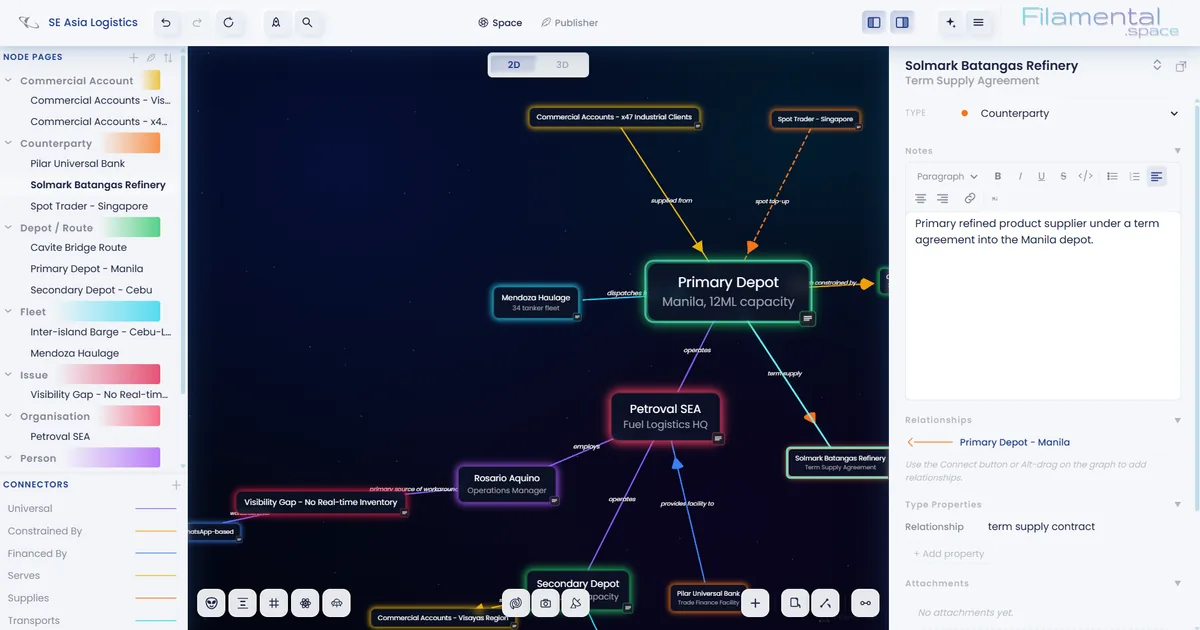
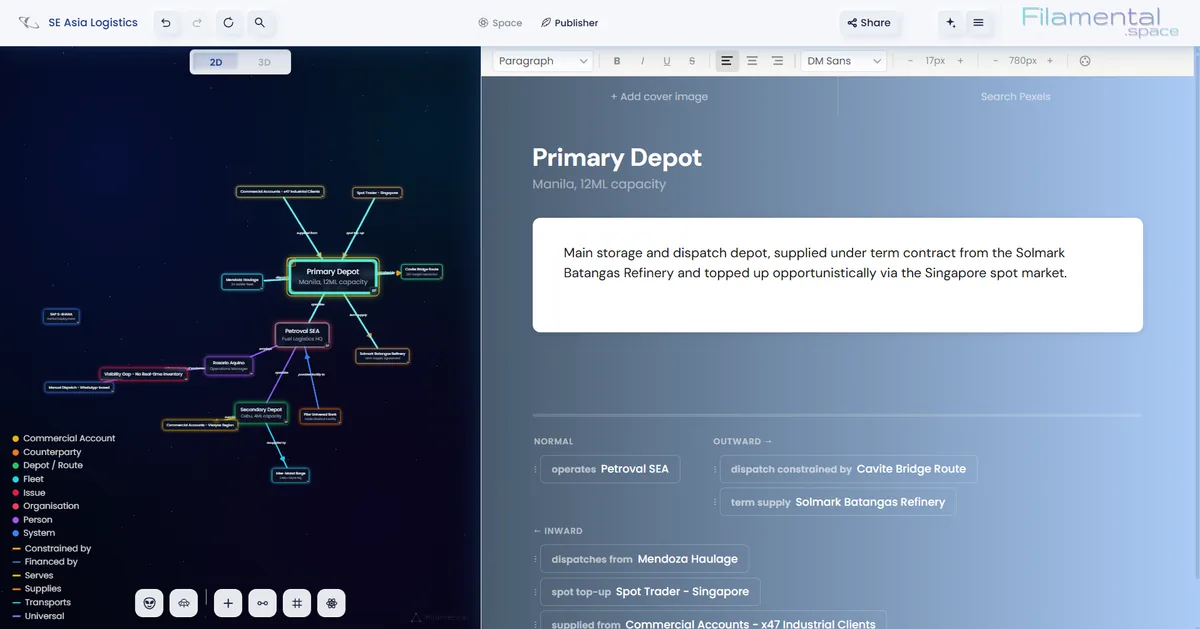
A fuel distributor operating across an archipelago. A main depot and a smaller regional one, a contracted road tanker fleet, an inter-island barge leg, industrial accounts and a retail forecourt network. Supply arrives under a term agreement from a refinery and gets topped up on the spot market when term volume and demand fail to line up. On paper it’s a distribution business with a stock control problem, and the brief was written that way.
Laid out, three things sit adjacent that had never been adjacent before. The enterprise system went live for finance and procurement and stopped short of depot inventory and dispatch. The regional depot is resupplied by exactly one barge leg. And a weight restriction on the bridge out of the main depot caps a loaded tanker, so a misjudged dispatch doesn’t cost a delay, it costs a full re-route.
The node they all connect to isn’t a system but the operations manager, because the real-time picture of which tankers are where and which depot is running low exists in her head and in a group chat. The finding isn’t that the business needs inventory software but that its early-warning function is one person, and it’s unavailable the day she is.
There’s no integration to scope, no credentials to request, no read access to negotiate and no security review to sit through. On a twelve-week engagement an integration you can’t start until week five isn’t an asset. You build the model from what you are told and what you are shown, which is what you were doing anyway, and you’re doing it three weeks earlier.
It’s a desktop application reading a folder on your own machine, with no account, no sign-in, no cloud storage and no telemetry of any kind. There’s no sub-processor to disclose and nothing to add to an engagement letter: if your laptop is inside the NDA, so is this. Your notes are plain text and the structure is yours, so handing the folder over at the end is a decision rather than an export.
And it isn’t a drawing. A diagram is a picture you maintain by hand and it stops being true the week you move on. Keep whatever you build slides in, because this won’t do that either. This is for the model behind them.
At the end of the engagement the space goes out as a link or a single file that opens in an ordinary browser, with the structure navigable, the reasoning attached where it belongs and the documents alongside it. Nobody installs anything, nobody creates an account, and it still opens in three years when the person who commissioned you has moved on and their successor is asking why the operation is arranged this way.
That changes what you are selling. A deck is evidence that you thought; a model is the thinking itself, and it’s considerably harder to argue with in a steering committee than a slide is. It also makes the follow-on engagement a continuation rather than a rebuild, because the client can point at the exact part of their own operation they now want looked at.
The quieter benefit is on your side. Templates ship with the application and a space is only a folder, so the structure you refine over three engagements in the same sector becomes the thing you start engagement four from. That is a fortnight of week-one work you stop repeating.
You don’t begin with a blank screen. A Template is a starting vocabulary, the kinds of thing that exist in a job and the ways they relate, so the categories are already there and already coloured when you make a space.
There’s no Template called Consulting, and there isn’t going to be, because consulting is a job done to somebody else's domain rather than a domain of its own. Start from whichever one matches the client: Supplier Network and Supply Chain Risk for an operations brief, System Component Map for a technology one. They’re all editable, and nothing stops you using more than one in a space.
Most people who read this site never need the paid tier, and we say so on their pages. You’re the exception, because the one thing it unlocks is handing the structure to somebody who doesn’t have Filamental, and that’s your deliverable rather than a convenience.
It is $120 a year, or $12 a month, and that’s the whole price list. Not per client, not per engagement, not per seat and not a percentage of anything. Set against a day rate it’s a rounding error on a single engagement, and it’s the only thing on this page you can’t do for nothing.
Everything before the sending is free permanently, with no account and no card, so building the model and working inside it costs you nothing whether or not you ever hand one over. Spaces are unlimited and the bridges joining them are free, so each client is its own space, kept separate, which is what your obligations require anyway.
Yes, and it’s the reason most consultants pay for this. Publisher turns a space into a document you send as a link or a single HTML file, and it opens in an ordinary browser with the structure navigable inside it. The client installs nothing, creates no account and pays nothing, and they can still open it in three years. You can also simply hand over the folder itself, since it’s Markdown files and belongs to whoever holds it.
No, and on this kind of work that’s a feature rather than a limitation. There’s no integration to scope, no credentials to request, no security review to sit through and no data processing agreement to negotiate before you can start thinking. You build the model from what you are told and what you read, which is what you were doing anyway, three weeks earlier than an integration would have let you.
That it’s a desktop application reading files on your own machine, with no account, no sign-in, no cloud storage and no telemetry of any kind. Nothing is uploaded and nothing is collected, so there’s no sub-processor to disclose and nothing to add to an engagement letter. If your laptop is already covered by the NDA, so is this.
Yes. More than sixty Templates ship with the application, each one a starting vocabulary of the things that exist in a kind of work and the ways they relate, and you can edit any of them or build your own. Since a space is just a folder, your own house structure is a folder you copy at the start of an engagement, which is how most people end up working after the second one.
A diagram is a picture you draw and then maintain by hand, and it stops being true the week the engagement moves on. Here the structure is the data: nodes carry notes, properties and attachments, relationships are typed and walkable in both directions, and the layout is generated rather than positioned by you. It’s closer to a model you can interrogate than to a drawing you have to keep accurate.
Building and reading a structure is free permanently, with no account and no card. The paid tier is $120 a year or $12 a month, it isn’t per client or per engagement, and it buys the one thing this audience actually wants: handing a space to somebody who doesn’t have Filamental. Unlike most readers of this site, you probably will pay, and it’s likely to be the smallest line on any engagement you run.
One engagement is enough to find out whether this suits how you work. Free to build in, no account, no card, and nothing that leaves your machine.