
Your data room holds the documents. It doesn’t hold the deal: the dozen findings that actually decide it, what each one is worth, which contract it came out of and which decision it’s holding up. That is a different artefact, it belongs on your side of the table, and right now it’s a spreadsheet and somebody's memory.
The room is indexed, the disclosure schedule is on revision four, and every contract anybody has asked for is uploaded. None of that is the problem, which is that a change of control clause is a paragraph on page thirty-one of a services agreement, and the reason it could cost you a tenth of your revenue is in counsel's red-flag memo, or an email thread, or the finance director's head.
So a question arrives, and somebody senior reconstructs the answer from the paper. Then it arrives again from the other side of a dual track a fortnight later, and they do it again. The one artefact everybody needs is the one nobody is keeping.
Give the finding its own place, not the contract it lives in but the finding itself: the consent right, the unsigned assignment, the key-person exposure, the single-source dependency. It carries what it is worth and whether it is still open, it points back to the paper it came out of and the counterparty it binds, and it points forward to the decision it’s holding up, written once by whoever found it.
The documents come too, since the disclosure schedule, the cap table, the financial statements and the buyer question log attach to the node they concern and open in Excel or Acrobat exactly as they would from a folder, unconverted and not trapped in a format only we can read.
What that buys is a straight answer to the only four questions anybody asks during a process: what is still open, what is it worth, whose desk is it on, and what does it stop. Answerable by anyone on the team, rather than by the two people who have been living in it.
Kestrel Dynamics, Denver, industrial sensors, founded 2015, 145 people, 58 million dollars of revenue over the last twelve months. It is running a dual track through the third quarter: a Series D led by one growth equity firm, and an outright acquisition by an industrial conglomerate as the parallel option. Both are in diligence at the same time, and the board picks a path in August.
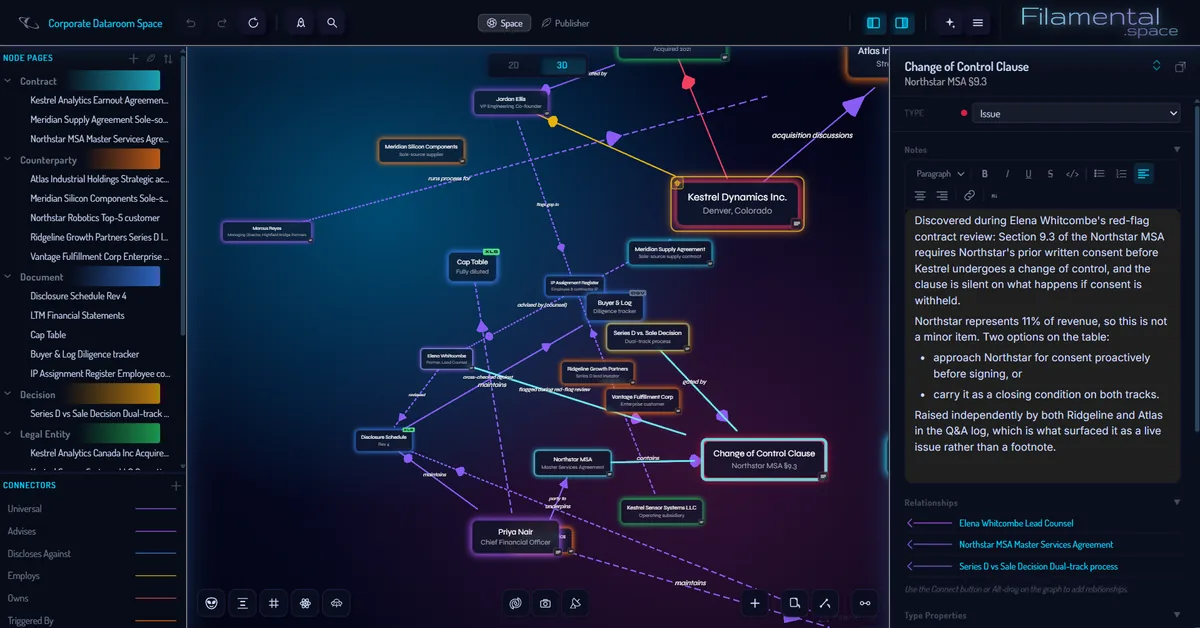
Counsel's red-flag review turned up section 9.3 of the master services agreement with the largest customer: written consent required before any change of control, and the clause says nothing at all about what happens if consent is withheld. That customer is 6.4 million dollars a year, eleven per cent of revenue. Both counterparties raised it independently in the question log, a fortnight apart, which is what turned it from a footnote into a live item.
It’s one node. Its properties carry the clause reference, the money at risk and that it is still open. It points back at the agreement it sits in and the customer it binds. And it points forward at the board decision, which records that it’s gated by exactly three things: the valuation gap, this consent question, and whether the VP of engineering stays.
He is worth a node too, and not for sentimental reasons. He wrote the earnout milestone definitions from the 2021 acquisition, which run to 2027 and aren’t self-explanatory on the page. If he leaves, the company negotiates milestone disputes without the author of the language. That isn’t a fact about a document, nor is it in the data room, and before it was written down it wasn’t anywhere.
No permissioning, no watermarking, no per-document access log, no way to let a counterparty in and no audit trail to produce afterwards. That is the whole job of a virtual data room and this doesn’t do any of it. Keep the room you’re paying for, and keep serving documents from it.
This sits on your side of the table. It’s a folder on your own machine with no account, no sign-in and no server it needs to reach, your notes saved as plain text and your attachments as the original files. There’s no telemetry in the application, none, which also means there’s no vendor questionnaire, no security review and no procurement step between deciding to try it and using it on Monday. During a live process that is usually the difference between a tool being used and being talked about.
A process runs on a handful of people holding different parts of it. Counsel found the clause. The banker knows where each counterparty actually is. The finance director knows the story behind every number in the disclosure. The board sees a deck once a month and has to choose a path from it.
A space can be sent as a link or as a single file that opens in an ordinary browser, so counsel gets the open items with the contracts they came from, and the board gets the decision with the three things gating it rather than a bullet list asserting them. They install nothing, pay nothing and have no account.
A snapshot is encrypted on your own machine before it goes anywhere, so what reaches us is ciphertext and stays that way. We can’t read it, and there’s no setting that changes that because it isn’t a setting. A password, if you add one, is a separate control over who gets in once they have the link. A hosted link expires by itself after 180 days and can be revoked at any time before that. This is for your own side and your advisers, while the counterparties still go through the room.
You don’t begin with a blank screen. A Template is a starting vocabulary, the kinds of thing that exist in a job and the ways they relate, so the categories are already there and already coloured when you make a space.
Regulatory Compliance and Investment Thesis ship too, and nothing stops you using more than one in a space. A starting point, not a schema you’re stuck inside: rename a category, add one, delete the ones you never use.
Everything described up to this point is on the free plan: no account, no card, no trial running out and no capability quietly withheld. Attachments aren’t limited and never will be.
A live transaction won’t fit in one space, and it isn’t supposed to. Spaces are unlimited, each holds twenty nodes, and the bridges between them are free and don’t count against that, so a process becomes several linked spaces rather than one enormous one: the corporate structure in one, contracts and open items in another, counterparties in a third, joined and navigable as a whole.
The paid tier is $120 a year, or $12 a month, and it buys exactly one thing: sending a space to somebody who doesn’t have Filamental. On a live process that is the board pack and the note to counsel, so unlike most of the people who use this, a deal team will generally want it. Worth saying plainly rather than discovering at the point you need it.
No, and you shouldn’t use it as one. It has no permissioning, no watermarking, no per-document access logs and no way to let a counterparty in, which is the entire job of a virtual data room. Filamental sits on your side of the table: it’s where the deal team keeps what the documents mean, while the documents themselves stay in whatever room you’re already paying for.
No. Those serve documents to counterparties under permissions with an audit trail, and they’re good at it. What none of them holds is the reasoning: which open items are live, what each is worth, which contract it came out of and which decision it’s blocking. That is a different artefact, usually living in a spreadsheet and one person's memory, and Filamental is where it goes instead.
In a folder on your own machine, and nowhere else. There’s no account, no sign-in and no server it needs to reach, and there’s no telemetry in the application at all. That also means no vendor questionnaire, no security review and no procurement step before a deal team can start using it, which during a live process is usually the difference between using something and not.
It’s a folder of plain files, so it lives wherever your team already keeps shared files and everyone opens the same one. What it doesn’t do is real-time co-editing: there’s no live sync and no presence, so two people typing into the same node at the same moment isn’t a supported thing. In practice one person owns the space, which on a sell-side process is usually true of the disclosure anyway.
Yes, as a link or as a single HTML file that opens in an ordinary browser. They install nothing, pay nothing and need no account, and they get the structure rather than a flattened summary. A snapshot is encrypted on your own machine before it goes anywhere, so what we hold is ciphertext and we can’t read it whether or not you set a password. Links expire by themselves after 180 days and can be revoked at any time.
Building the space costs nothing. The Personal plan is free permanently with no account and no card, and it covers unlimited spaces with free bridges between them. The paid tier is $120 a year, or $12 a month, with no per-seat ladder and no per-deal fee, and it buys one thing: handing a space to somebody who doesn’t have Filamental. On a live process that tends to be the board pack, so a deal team will usually want it.
You know what they are. Give each one what it is worth and what it is blocking, and you’ll have the artefact nobody has been keeping. Free, no account, no card, and nothing to cancel if it turns out it doesn’t suit you.