
You don’t draw it. You record what you found and what it connects to, and the chart assembles from that, correct every time you open it. Every line on it traces back to the document that put it there, so the answer to how do we know is a click rather than an afternoon.
The case is a spreadsheet of entities, a chronology in Word, a folder of PDFs named after the URLs they came from, and thirty tabs you dare not close. It works, because you’re holding the shape of it in your head while you work.
Then you come off it for a fortnight. Or someone senior asks how you know. Or it goes to a colleague. And the shape is the one part that was never written down, so it gets rebuilt from the documents, and rebuilt again the next time somebody asks.
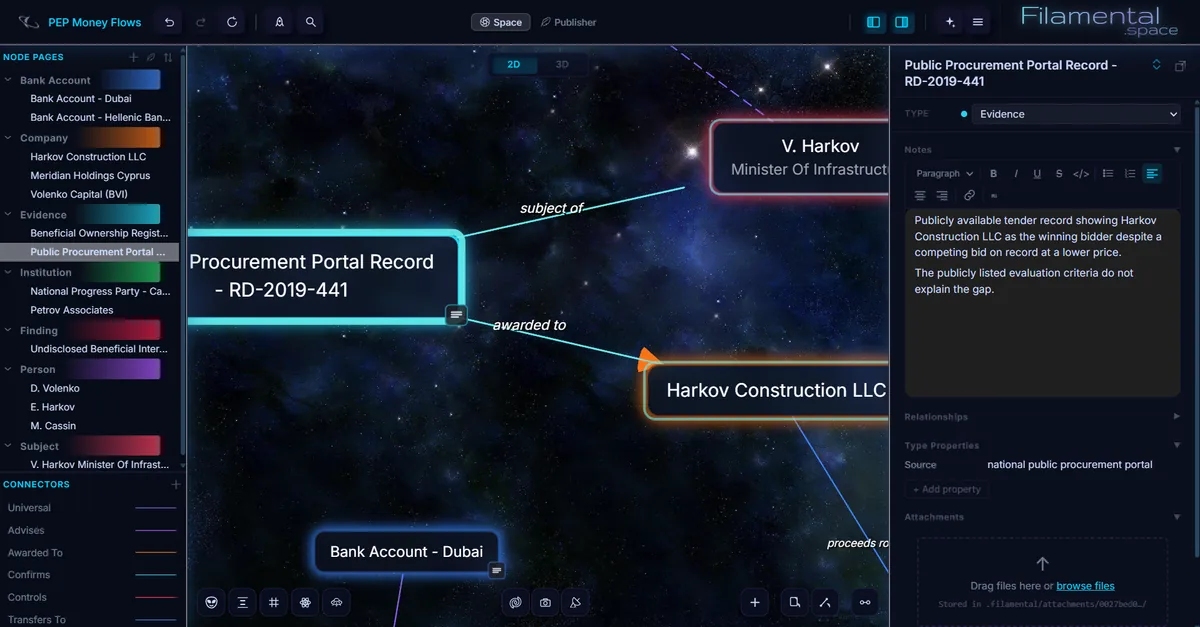
Every person, company, account, document and finding is a node. When you establish that one of them bears on another, you say so on the node itself, in a phrase: controls, transferred to, confirms, advised by. That’s a sentence you would have written into your notes anyway. The difference is that this one is also structure, so the picture builds itself out of the work rather than after it. Nothing is drawn, which means nothing has to be redrawn when the third shell company turns up.
Because the connection is a real object rather than a line on a diagram, it can carry things. A transfer has a direction, a label and a place to keep the statement that evidences it. A registry filing sits on the finding it confirms. The original PDFs, the printouts and the screenshots attach to the node they support and open in whatever program normally opens them, unconverted and not trapped in a format only we can read.
So the route from a claim back to its proof exists in the file rather than in your memory of building it, and it runs in both directions, so anybody holding the case can walk it. That’s the difference between a case you can explain and a case you can hand over.
A Minister of Infrastructure, in post since 2017. A publicly available procurement record showing his own ministry awarded a major tender to a construction company registered the year before, with no prior contract history of comparable scale, over a competing bid on record at a lower price. The published evaluation criteria don’t explain the gap.
The proceeds move to a holding company in Cyprus incorporated four months before that tender was published, with no employees and a registered capital of a thousand euros, whose sole director is the minister's spouse. From there a further transfer reaches a British Virgin Islands entity beneficially owned by an energy businessman who has known him for years, and the money then splits between an account in Nicosia holding 4.2 million dollars and one in Dubai holding 38 million. One law firm incorporated both shells inside the same four month window. One of the three people on the procurement board that approved the award has no declared conflict of interest on file.
The whole case is a small structure, and the finding is one node in it. It says the winning bidder is connected, through two layers, to the awarding minister's own household. Pointing at it is a single filing from the Cyprus corporate registry, and that filing is the anchor the rest of the case hangs from. The claim and the document that proves it are attached to each other, so they can’t drift apart while the file sits in a drawer for eight months.
Whether this ends up as a compliance filing, a published story or a prosecution file depends entirely on who is holding it. The structure underneath is the same either way.
There’s no account, no sign-in, no license portal, no sync client and no server it needs to reach. You point it at a folder on your own disk and it reads what is there. Your notes are saved as plain text and your attachments are the original files, so the case is readable with or without us and survives us entirely. There’s no telemetry in the application, not reduced telemetry or anonymous telemetry, none, which for live work is the difference between usable and not.
It also gathers nothing on your behalf. No transforms, no data feeds, no enrichment, no scraping and no automated lookups, and it makes no outbound request for you. Everything in a space is something you put there, from sources you obtained lawfully yourself. If you run a tool that does collection, keep it and keep using it. This is where what you worked out from the results goes.
Every case is eventually read by someone who didn’t build it. An editor with a lawyer beside them. A compliance committee. Counsel deciding whether there is enough. A client who is paying for a conclusion and will ask how you reached it. What they usually get is a report, which is the shape flattened into paragraphs, with the structure you spent weeks establishing left behind in your working files.
A space can be sent as a link or as a single file that opens in an ordinary browser. They install nothing, pay nothing and have no account, and they can move through it the way you did rather than reading your summary of it.
A snapshot is encrypted on your own machine before it goes anywhere, so what reaches us is ciphertext and stays that way. We can’t read a shared case, and there’s no setting that changes that because it isn’t a setting. If you add a password, that’s a separate control deciding who gets in once they have the link; the encryption was never the optional part. A hosted link expires by itself after 180 days and you can revoke it at any time before that.
You don’t begin with a blank screen. A Template is a starting vocabulary, the kinds of thing that exist in a job and the ways they relate, so the categories are already there and already coloured when you make a space.
Research & Fact-Check, Source Network, Investigation Timeline, Fraud Investigation and Transaction Network ship too, and nothing stops you using more than one in a space. A starting point, not a schema you’re stuck inside: rename a category, add one, delete the ones you never use.
Everything described up to this point is on the free plan: no account, no card, no trial running out and no capability quietly withheld. Attachments aren’t limited and never will be.
A case of any real size won’t fit in one space, and it isn’t supposed to. Spaces are unlimited, each holds twenty nodes, and the bridges between them are free and don’t count against that, so a case becomes several linked spaces rather than one enormous one: a space per entity cluster, per strand, per subject, joined and navigable as a whole. That is also how you would want a large case laid out anyway.
The paid tier is $120 a year, or $12 a month, with no per-seat ladder above it, and it buys exactly one thing: sending a case to somebody who doesn’t have Filamental. For professional work that tends to be the entire point, so unlike most of the people who use this, you’ll probably end up paying for it. Worth saying plainly rather than discovering later.
No, and it does a different job. Those tools are built to gather: transforms, data feeds and enrichment that go out and return results. Filamental gathers nothing and has no lookups of any kind. It’s where what you worked out from those results is kept, structured and evidenced, in a form you can hand to somebody else. If you run a collection tool, keep it.
In a folder on your own machine, and nowhere else. Filamental is a desktop application for Windows, macOS and Linux with no account, no sign-in and no server it needs to reach. Notes are saved as plain text files and attachments are the original files. There’s no telemetry in the application at all, so nothing about a case leaves the disk unless you deliberately publish it.
That’s the point of building it this way. A finding is a node, the document that supports it is a node, and the link between them is a real object with a direction and a label rather than a line on a picture. The source file itself attaches to the node it evidences and opens in whatever program normally opens it. Anybody holding the case can walk from a claim to its proof, not just the person who built it.
Yes, as a link or as a single HTML file that opens in an ordinary browser. The recipient installs nothing, pays nothing and needs no account, and they get the structure rather than a flattened summary. A shared snapshot is encrypted on your own machine before it goes anywhere, so what we hold is ciphertext and we can’t read it whether or not you set a password. Links expire by themselves after 180 days and can be revoked at any time.
No. It has no data providers, no transforms, no scraping and no automated lookups, and it makes no outbound request on your behalf. Everything in a space is something you put there, from sources you obtained lawfully yourself. It’s a place to structure and evidence what you have, not a way of acquiring more of it.
Building the case costs nothing. The Personal plan is free permanently with no account and no card, and it covers unlimited spaces with free bridges between them. The paid tier is $120 a year, or $12 a month, with no per-seat ladder above it, and it buys one thing: handing a finished case to somebody who doesn’t have Filamental. For professional work that’s usually the deliverable, so most people doing this for a living will end up paying for it.
Three names and the two links between them is enough to see whether this suits the way you work. Free, no account, no card, and nothing to cancel if it turns out it doesn’t.