
You don’t draw it. You record what you found and what it connects to, and the chart assembles from that, correct every time you open it. Every line on it traces back to the document that put it there, so the answer to how do we know is a click rather than an afternoon.
The case is a spreadsheet of entities, a chronology in Word, a folder of PDFs named after the URLs they came from, and thirty tabs you dare not close. It works, because you’re the case’s systems thinker, holding the shape of it in your head while you work.
Then you come off it for a fortnight. Or someone senior asks how you know. Or it goes to a colleague. And the shape is the one part that was never written down, so it gets rebuilt from the documents, and rebuilt again the next time somebody asks.
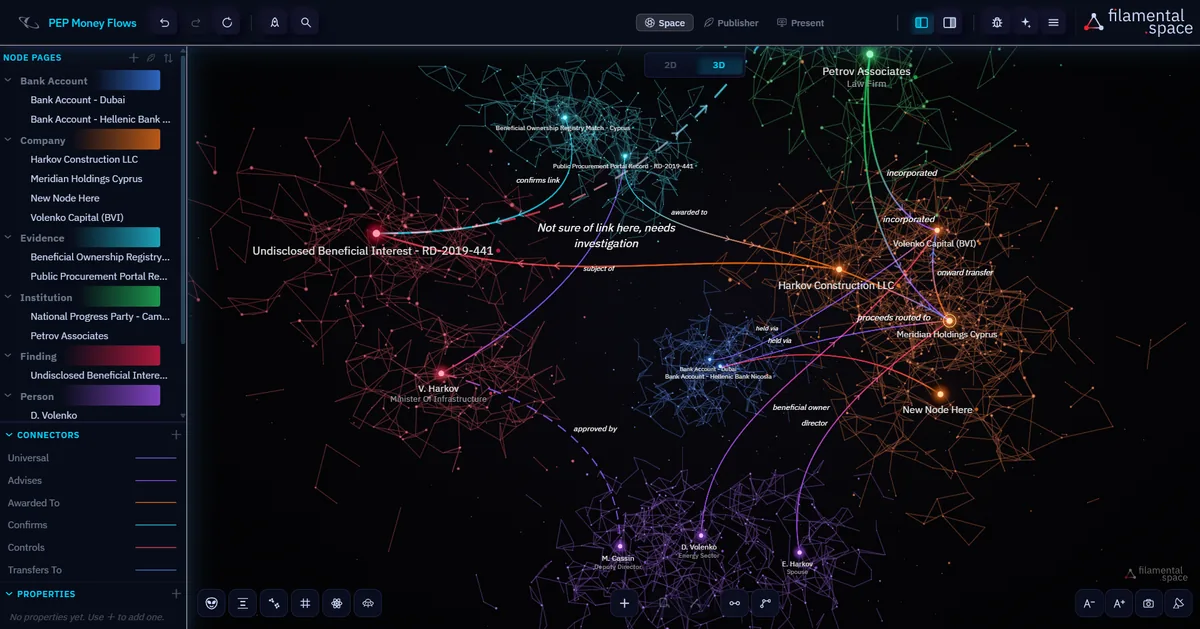
Every person, company, account, document and finding is a node. When you establish that one bears on another, you say so on the node in a phrase, controls, transferred to, confirms, which is a sentence you’d have written anyway, except that this one is also structure, so nothing has to be redrawn when the third shell company turns up.
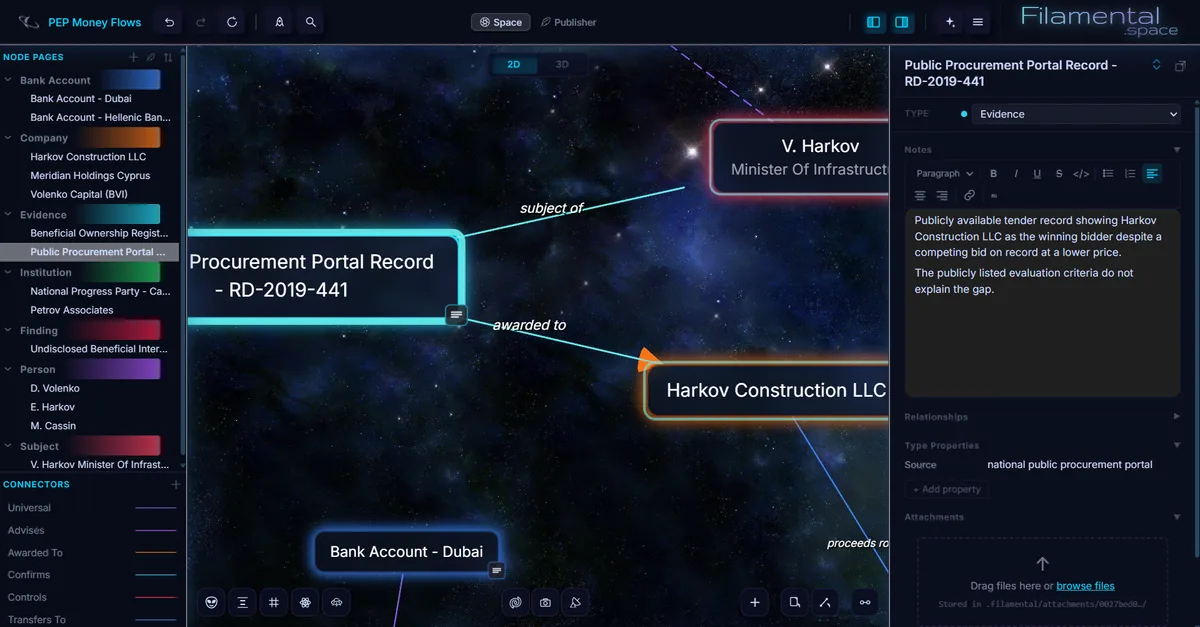
Because the connection is a real object, it can carry things: a transfer has a direction, a label and the statement that evidences it, and the original PDFs and screenshots attach to the node they support, unconverted.
So the route from a claim back to its proof exists in the file rather than in your memory of building it, and it runs in both directions, so anybody holding the case can walk it. That’s the difference between a case you can explain and a case you can hand over.
A Minister of Infrastructure, in post since 2017. A publicly available procurement record showing his own ministry awarded a major tender to a construction company registered the year before, with no prior contract history of comparable scale, over a competing bid on record at a lower price. The published evaluation criteria don’t explain the gap.
The proceeds move to a Cyprus holding company incorporated four months before the tender was published, with no employees and a thousand euros of capital, whose sole director is the minister’s spouse. From there a transfer reaches a British Virgin Islands entity owned by an energy businessman who has known him for years, and the money splits between accounts in Nicosia and Dubai. One law firm incorporated both shells inside the same four month window.
The finding is one node: the winning bidder is connected, through two layers, to the awarding minister’s own household, and pointing at it is a single filing from the Cyprus corporate registry. The claim and the document that proves it are attached to each other, so they can’t drift apart while the file sits in a drawer for eight months.
Whether this ends up as a compliance filing, a published story or a prosecution file depends entirely on who is holding it. The structure underneath is the same either way.
There’s no account, no sync client and no server it needs to reach. Your notes are plain text and your attachments are the original files, so the case survives us entirely, and there’s no telemetry in the application at all, which for live work is the difference between usable and not.
It also gathers nothing on your behalf: no transforms, no data feeds and no automated lookups. If you run a tool that does collection, keep using it, since this is where what you worked out from the results goes.
Every case is eventually read by someone who didn’t build it: an editor with a lawyer beside them, a compliance committee, counsel, a client paying for a conclusion. What they usually get is a report, the shape flattened into paragraphs.
A space can be sent as a link or as a single file that opens in an ordinary browser. They install nothing, pay nothing and have no account, and they can move through it the way you did rather than reading your summary of it.
A snapshot is encrypted on your own machine before it reaches us, so we can’t read a shared case, and a hosted link expires by itself after 180 days or whenever you revoke it.
A Template is a starting vocabulary, so the categories arrive named when you make a space.
Research & Fact-Check, Source Network, Investigation Timeline, Fraud Investigation and Transaction Network sit next door, and any Template can be renamed, extended or combined with another.
Everything up to this point is on the free plan, with no account and no card, and attachments aren’t limited. Spaces are unlimited, each holds twenty nodes, and the bridges between them are free, so a large case becomes linked spaces per entity cluster or strand, which is how you’d want it laid out anyway.
Professional has nothing above it, and keeps a big case whole in one space, sends it to somebody who doesn’t have Filamental and presents it. For professional work that tends to be the entire point, so you’ll probably end up paying for it.
No, and it does a different job. Those tools are built to gather: transforms, data feeds and enrichment that go out and return results. Filamental gathers nothing and has no lookups of any kind. It’s where what you worked out from those results is kept, structured and evidenced, in a form you can hand to somebody else. If you run a collection tool, keep it.
In a folder on your own machine, and nowhere else. Filamental is a desktop application for Windows, macOS and Linux with no account, no sign-in and no server it needs to reach. Notes are saved as plain text files and attachments are the original files. There’s no telemetry in the application at all, so nothing about a case leaves the disk unless you deliberately publish it.
That’s the point of building it this way. A finding is a node, the document that supports it is a node, and the link between them is a real object with a direction and a label rather than a line on a picture. The source file itself attaches to the node it evidences and opens in whatever program normally opens it. Anybody holding the case can walk from a claim to its proof, not just the person who built it.
Yes, as a link or as a single HTML file that opens in an ordinary browser. The recipient installs nothing, pays nothing and needs no account, and they get the structure rather than a flattened summary. A shared snapshot is encrypted on your own machine before it goes anywhere, so what we hold is ciphertext and we can’t read it whether or not you set a password. Links expire by themselves after 180 days and can be revoked at any time.
No. It has no data providers, no transforms, no scraping and no automated lookups, and it makes no outbound request on your behalf. Everything in a space is something you put there, from sources you obtained lawfully yourself. It’s a place to structure and evidence what you have, not a way of acquiring more of it.
Building the case costs nothing. The Personal plan is free permanently with no account and no card, and it covers unlimited spaces with free bridges between them. The paid tier has nothing above it, and is for handing a finished case to somebody who doesn’t have Filamental, or presenting it to them. For professional work that’s usually the deliverable, so most people doing this for a living will end up paying for it.
Three names and the two links between them is enough to see whether this suits the way you work. Free, no account, no card, and nothing to cancel if it turns out it doesn’t.