Working in Space
The Unfair Advantage
Filamental is a working environment.
You can see everything, connect anything and it steals nothing.
Building Your World
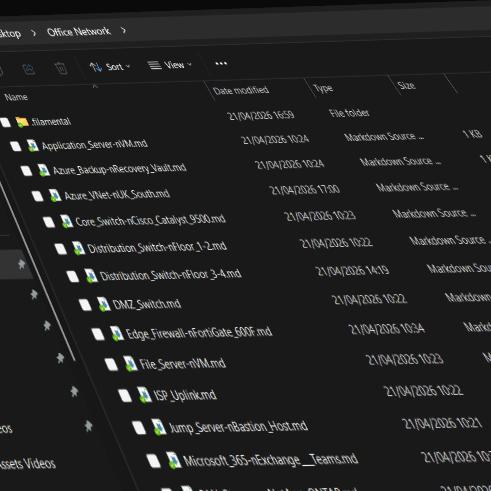
Create a folder on your machine or network - this is your Space or World
Give it a name
Select one of our industry Frameworks (templates) or start blank
Double-click anywhere to add a new Note Node
Alt-drag to connect
Manually move other files into the folder or use the Insert Menu to insert external file types and links
Total awareness
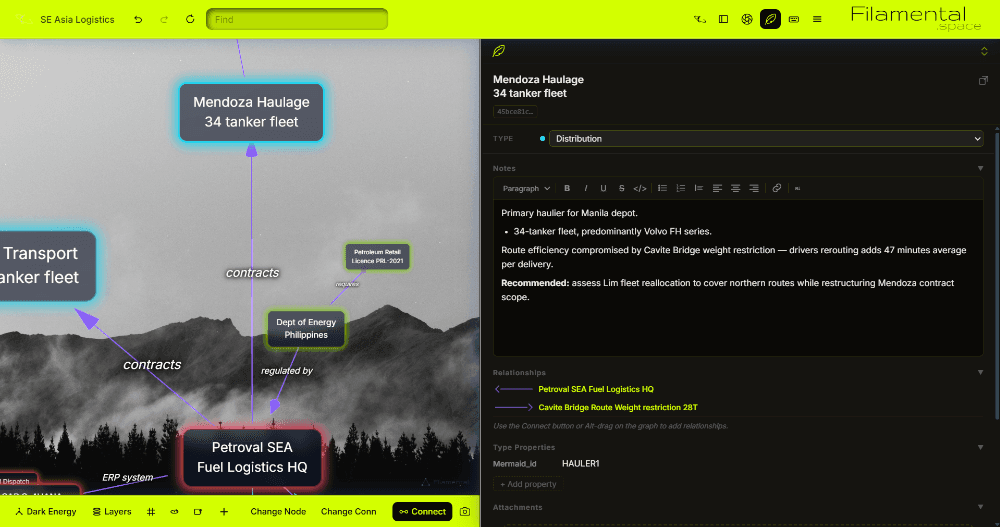
Sketch out a plan in 2D, flip to 3D to see the shape, back into 2D to sort the hierarchy… spin, drag, add, create!
Place your nodes and draw connections.
A single 'world' can hold multiple structures. Keep them separate, connect them when the relationship becomes clear.
Filamental is both a folder viewer and a folder creator.
Editing Your Work
Write full documents in any node
Use inline wikilinks
Attach files, images, links, references inside the node
Pop the node panel out and keep it to one side
Open external file types
Assign properties
See and follow connections
Control of your environment and knowledge is a superpower.
Navigating Your Space
Pinch, swipe, pan, drag, press, click
Navigating around is easy.
We use established and intuitive controls like arrow keys, two-finger swipes, even gamers will feel at home with WASD.
All there, all familiar.
Controls can be found by clicking the keyboard button in-app.
The only limits are your hardware and imagination.
Create Bridges between spaces and folders
Search content
Toggle layers to reduce noise
Use the grid to anchor your bearings
Share Your Thoughts
Export images and video 'drone' shots
Add beautiful, looping animated backgrounds (or upload your own)
Switch between themes to suit the moment, from quiet backgrounds to impactful presenting
"Wait, this is how you think?!"
Most of the time Filamental will operate as a working surface, but sometimes you may need to show your work.
For those times, you can have a little fun.
Filamental isn't performative, it just provides the environment to express your thoughts.
Most tools hide complexity behind simplicity.
Nested folders. Linear documents. Slide decks that pretend every system is a straight line.
That works until the system you are trying to understand is not simple.
We do not flatten your thinking to fit a page. We give you space to see the full shape of what you are working with, in three dimensions, as it actually is.
It is more demanding. It is also more honest.
If you would rather face the real map than be comforted by a false one, this is built for you.
Your work, your files
Everything you build is sovereign. It lives in your folders, in your network and is saved in open formats for infinite portability.
We do not want your data.
You created it, it belongs to you. It is yours, not ours.
Your work has value, you worked hard to create it.
Theft is not a business model.

Some Windows users may receive a security prompt. Select More info, then Run anyway or download via the Windows Store.
No card or account required.
Why Filamental is made this way
Most software is now delivered through a browser, funded by venture capital, and designed to maximise the time you spend inside it. The incentives of that model produce what they produce - relentless notifications, contrived urgency, features added for engagement… it's all rather tiring and self-important.
Filamental doesn't do that.
It is an application you install, deliberately, as a considered part of your working equipment rather than a relentless browser tab begging for your attention and torturing you with notifications.
The files it writes are yours, not ours, we do not demand your data or adoration.
We make the bet that users and companies still care about owning their data.
The industry changed, users didn't. The customers used to be considered the ones buying the product, not the ones investing in it.
You are not the product.
This is the application, this is our stance. The rest is up to you.