
You made the best explanation of this subject anybody has published, and the format gives them one sitting with it. A companion space gives them as long as they want: they come back to the part they needed, follow it into the thing it rests on, and take the workbook with them. Nobody subscribes to a video. They subscribe to keep building something, and this is the thing they are building.
You held the whole thing at once. Six ideas, the way they lean on each other, the two places everybody goes wrong, the example that makes the third one land. Then you flattened it into thirty-four minutes so it could be published, and now every viewer has to rebuild that shape from a line, at your pace, in one go.
They get the argument and the structure goes. Not through any fault of theirs: the workbook you held up on screen went into a description link that will be dead in a year, and the question you answered at fourteen minutes gets asked again on Thursday because there was no way back to it. Everything durable you made that day is inside a file nobody can walk around.
And that is the loss worth naming: the part of your work that earns somebody's loyalty is the part they still have next month.
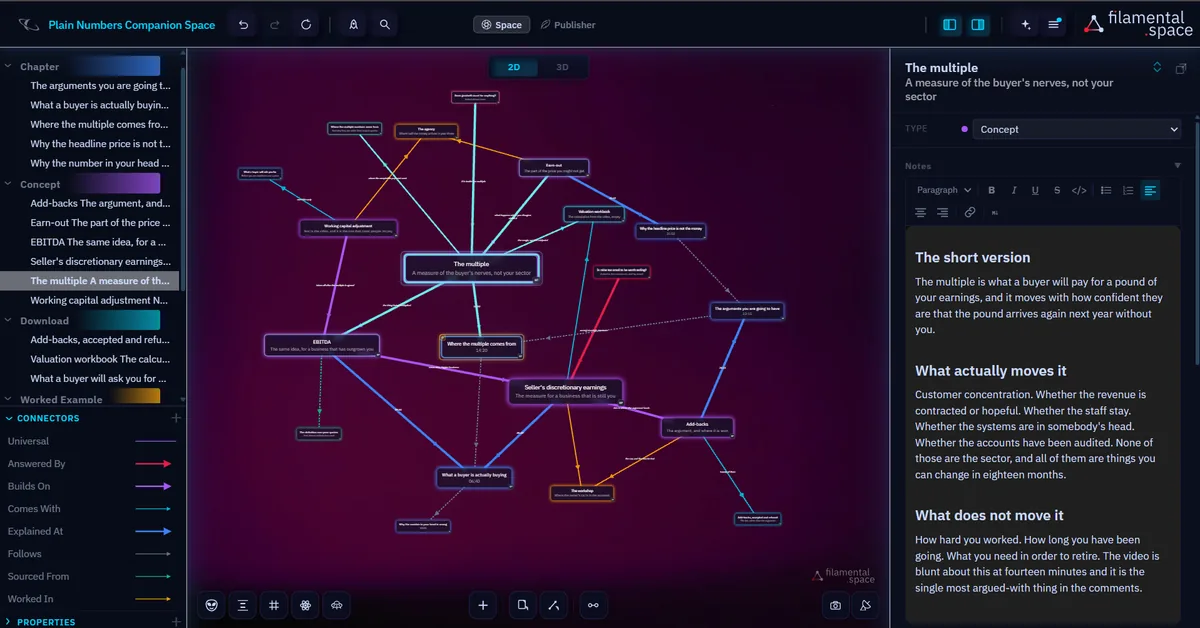
Each idea in the video is one thing in the space, and the minute it is explained at is written along the line joining it to the chapter it lives in. Somebody who wants the part about earn-outs does not drag a scrubber around looking for the bit where the waveform changes. They open the idea, read your note on it, and the time is sitting on it.
Then the ideas join to each other, which is the thing the format cannot do at all. This one leans on that one, which is a smaller version of the one before it. Somebody who starts in the wrong place can walk backwards until it makes sense, which is how people actually learn things and the opposite of how video delivers them.
And you can put the material on it. Drag the workbook onto the concept it calculates, the checklist onto the thing it prepares somebody for, the reference onto the claim it backs. Whoever opens the link sees each one on the page it belongs to, named, with its size beside it, and clicking it downloads it. Nobody is hunting a folder for a file called final-v3.
Plain Numbers is an invented channel. The video is thirty-four minutes on what a small business is actually worth, which is a subject that bounces: you cannot explain the multiple without the earnings measure, and you cannot explain the earnings measure without the argument about what counts. The space beside it is twenty nodes, which is exactly what a free space holds.
The five chapters, in order, with their times on them. They are the video's own spine and they are the first thing a viewer recognises, which is what makes the rest of it navigable rather than a diagram of somebody else's thinking.
A comment that answers itself. Does goodwill count for anything, asked eleven times, sits in the space as a question joined to the concept that answers it, and that concept carries the minute it is explained at. Two hops from a comment to the right ninety seconds of video. You answer it once, in the space, rather than eleven times underneath.
One concept that is not in the video at all. The working capital adjustment was cut at the second edit for time, and it is the one that costs people money. It is in the space, marked as not covered, with more written on it than any chapter got. A video has a running time. A space does not, and that is the part worth understanding: you are not limited to what you said.
The material, on the thing it belongs to. The valuation workbook hangs off the two concepts it calculates. The list of add-backs a buyer will accept and refuse hangs off the argument about add-backs, because a list should be a list and not a paragraph. The document checklist hangs off the thing it prepares somebody for. None of them are in a folder and none of them are in a description.
Connect Claude to a space, give it the script, and ask it to lay out what the video explains. It makes one thing per idea, joins them the way you joined them, writes your timestamps along the lines, and puts your own words on each one. You did the structural work when you wrote the thing. This is reading it back.
What comes out is roughly right, because a good script is already roughly the structure. Then it is your call how far you take it. Fix the two it misread, add the thing you cut for time, drop the workbook on, and stop. Or spend an hour and make it the best thing under the video. There is no state in which it is unfinished, which matters when the alternative is a job you keep not starting.
It does not have to be you, either. If publishing already assembles a thumbnail, a description and a set of links, a space and its address fit into the same pass. Claude reaches a space over MCP on every plan, free, with the files staying on your own disk.
Put the content into the structure. Space Studio is where it gets built: a page for each idea, the lines between them, your own notes on every one, and the files dropped onto whatever they belong to. This is the part the script does most of for you.
Give it character in Publisher Studio. The same space, a different room. Covers, type, colour, measure, and the order things arrive in. This is where it stops looking like somebody else's tool and starts looking like yours, which is most of whether anybody stays past the first page.
Then look at it, or stand next to it. Fill the screen, choose the ground it sits on, and move through it. That is the pass you make before you send it to anybody, and it is the same thing you screen-record when you want it in the video.
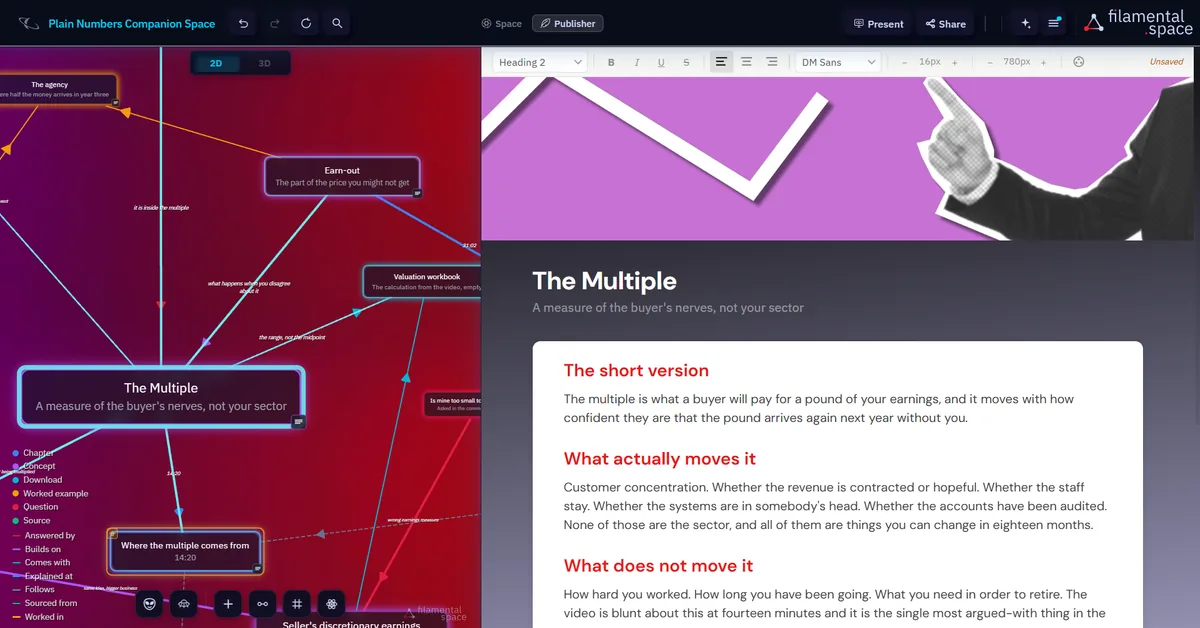
Create lasting bonds with material your audience can go back to time and again.
You can open it while you talk. Turning the structure, lighting up the part you are on, walking from one idea into the one it rests on: that is footage about your subject, made out of your own material, rather than a stock shot of somebody at a laptop. It took you an afternoon to build and it is not a motion graphic you commissioned.
And if you sell something alongside the content, a course or a membership or a paid tier of the newsletter, this changes what it is. Most of what gets sold is a set of videos and a PDF, which is the same watching and reading the free version already was. A space is walked instead: somebody lands on the part they need, follows it to what it rests on, and takes the workbook that is attached to it. Discovery rather than delivery, and it looks like something that took work, because it did.
Say the honest thing first. If a subject is finished in one watch, a companion space is work that nobody opens, and you would be building it for the idea of an audience rather than the one you have. This suits people explaining things complicated enough to be returned to: long explainers, technical series, anything where somebody is taking notes while you talk. If your audience saves your videos, it is for you. If they scroll past them, it is not.
For everything else, it is smaller than it looks. There are no tasks, no assignees, no schedule and no notifications. It does not want your footage, it will not cut or upload anything, and it has no opinion about how often you post. Your notes are plain text files in a folder you chose on your own machine, so stopping tomorrow costs you nothing, and there is no account, no sign-in and no telemetry, which matters while a video is still unlisted.
It will not grow your channel either. Keep whatever does that.
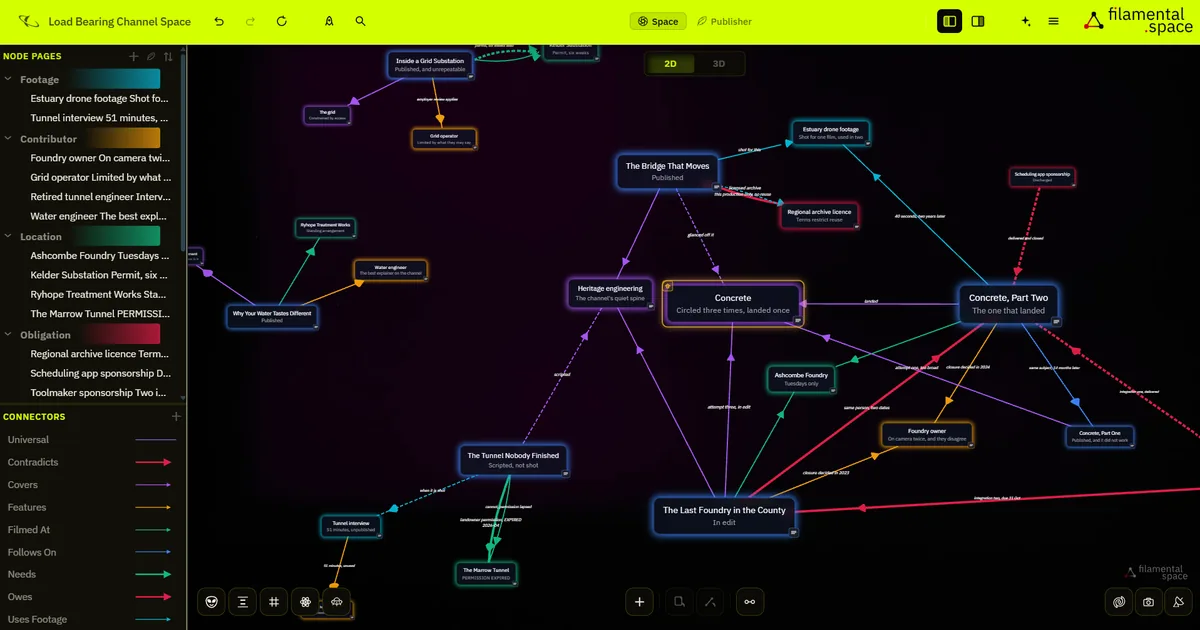
Nothing stops you running the production side in it, and some people will. A contributor becomes one thing with every video they appear in hanging off it, so two incompatible things they said fourteen months apart sit side by side. A location carries the permission it needs and the date that permission runs out. A topic you have circled three times holds all three attempts, in order, with a note on each about what it failed to do.
It is a real use and it is not what this page is about. If it is what you came for, the shape is the same: things, joined, with the files on them.
Everything above assumes you already understand the subject and the problem is handing it over. If the problem is the other one, working out what is actually going on across forty sources, six months and a subject that keeps moving, that is a different use of the same tool and it is better argued somewhere else.
Every claim sits on the document that produced it, so how do we know is a click. The picture assembles from what you found rather than being drawn, and it is correct every time you open it. The investigation page makes that case properly.
You do not begin with a blank screen. A Template is a starting vocabulary, the kinds of thing that exist in a job and the ways they relate, so the categories are already there and already coloured when you make a space.
Take one and change every word of it if you want to. The worked example above started as Learning Design and ended up with chapters, questions and downloads in it, because that is what one video turned out to be made of. The vocabulary is yours, and a Template is only the thing that saves you naming six categories before you have started.
Be straight about it. Leaving a companion under every video needs the paid tier, because they all have to be live at the same time. There is no version of this where you do it properly for nothing, and you should know that before you spend an evening on it rather than after.
Do not start there, though. The free plan keeps one live link at a time, permanently, with no account and no card: publish a companion, put it under a video, and watch what your audience actually does with it. Take it down when you have your answer and the next one is free too. Building costs nothing either way, spaces are unlimited, and attachments are not capped at all, which is the part that matters when the workbook is the point.
Use those first few to find your own version of it. It usually takes two or three goes: the first is too thin, the second tries to put the whole subject in, and the third is the one you would put your name on. That is a couple of evenings before you have paid us anything, and it is the right way round.
Professional is $120 a year, or $12 a month. It removes the limit, lets you push an updated version to an address people already have, and gives you the whole thing as a single HTML file with no expiry, which is the one to use under a video that will still be watched in two years. Your audience pays nothing either way.
Nothing stops anybody else doing this. Almost nobody does, which is most of the argument for being early.
You are in an unusual position with this one. Most things a creator is asked to recommend are things they do not use on camera. This is the opposite: if you build a companion for the video, the tool is already in the video, the audience has already watched you work in it, and the link under it is the one they were going to look for anyway.
The terms are 25% of every payment, recurring for as long as the subscription runs rather than once, with a 180 day window. No exclusivity, no minimum audience, nothing to report. The affiliate page has the whole of it.
A web address, or a single HTML file. It opens in an ordinary browser on a phone or a laptop, and what opens is the structure you built, navigable, with your notes on every part of it. Files you attached show up on the page they belong to, named and sized, and clicking one downloads it, so the workbook and the checklist travel with the thing rather than in a description. Nobody installs anything, nobody makes an account, and nobody pays.
The script is the input, so the first version is not written by hand. Connect Claude to a space, give it the script, and ask it to lay out what the video explains: it makes one thing per idea, joins them the way you joined them, and writes the timestamps on. Ten minutes gets you something worth sending. An hour gets you the best thing under the video. There is no point at which it is unfinished.
A hosted link lasts 180 days and then expires on its own, which is deliberate, because links that live forever are how confidential work gets found years later. For a video that keeps being watched, publish the space as a single HTML file instead: it has no expiry, you host it wherever you already host things, and it does not depend on us at all. The file is part of Professional.
No, and that is deliberate rather than a trial. What you send opens in the browser they already have, with nothing to install, no account, no sign-in and no charge, on any device. The paid line in Filamental is drawn at the point where work leaves your hands, never at the point where somebody receives it.
No. If a subject is simple enough to be finished in one watch, a companion space is work that nobody opens. This suits people explaining things complicated enough that the audience comes back to them: long explainers, technical series, anything where somebody takes notes. If your audience saves your videos rather than watching them once, it is for you.
Yes, and it changes the shape of what you are selling. Most of what gets sold alongside content is a set of videos and a PDF, which is the same watching and reading the free version was. A space is walked rather than played: somebody arrives at the part they need, follows it to what it rests on, and takes the workbook attached to it. You can publish one space per module or one for the whole thing.
One script and one evening is enough to find out whether your audience uses this, and the video is already made. Free, no account, no card, and nothing that leaves your machine.