For AI Workers
Creativity, Efficiency and Control
You are not just wiring APIs together. You are designing how intelligence flows through a system—what each component knows, what it decides, what it hands off, what it falls back to when the model returns something you did not expect.
This work does not fit in a flowchart. Flowcharts assume predictable behaviour. AI systems behave according to the structure of their context, their prompts, their constraints—the things you are designing but cannot yet see.
Filamental is where that design lives before it becomes code.
The thinking layer
Execution tools are improving. n8n runs workflows. LangChain chains calls. Vector databases retrieve context. Each does its job.
Yet none demonstrate the shape of what you are building. The dependencies between agents. The decision trees that branch into more decision trees. The prompts that depend on context the user has not provided. The fallbacks that only matter when the primary path fails.
Making AI explainable is crucial in a business. And being the one explaining it clearly sets you apart.
Filamental is the layer above execution. The place where you architect what the workshop will build, write the prompts that will drive it, and explain the design to the people funding it or depending on it.
If n8n is the workshop, Filamental is the drawing board. The output of the drawing board feeds the workshop.
Design for unpredictability
Traditional architecture diagrams assume the system behaves as drawn. AI systems do not. They behave according to a model whose decisions are themselves the thing being designed.
Mapping these systems is less about boxes and arrows and more about thinking through:
What does this component know?
What does it hand to the next?
What does it fall back to?
What does it do when the model returns something unexpected?
Filamental gives you a working surface where that thinking has somewhere to live, before it becomes code. Where you can adjust the structure as your understanding of the problem changes. Where the work is fluid because the medium is fluid.
Are you paying $200 a month for a pinky promise that, "we probably, might not, it's unlikely, steal your data to inflate our our valuation."
Filamental can't. It's literally impossible.
You deserve better.
How Filamental fits
Architect before you build
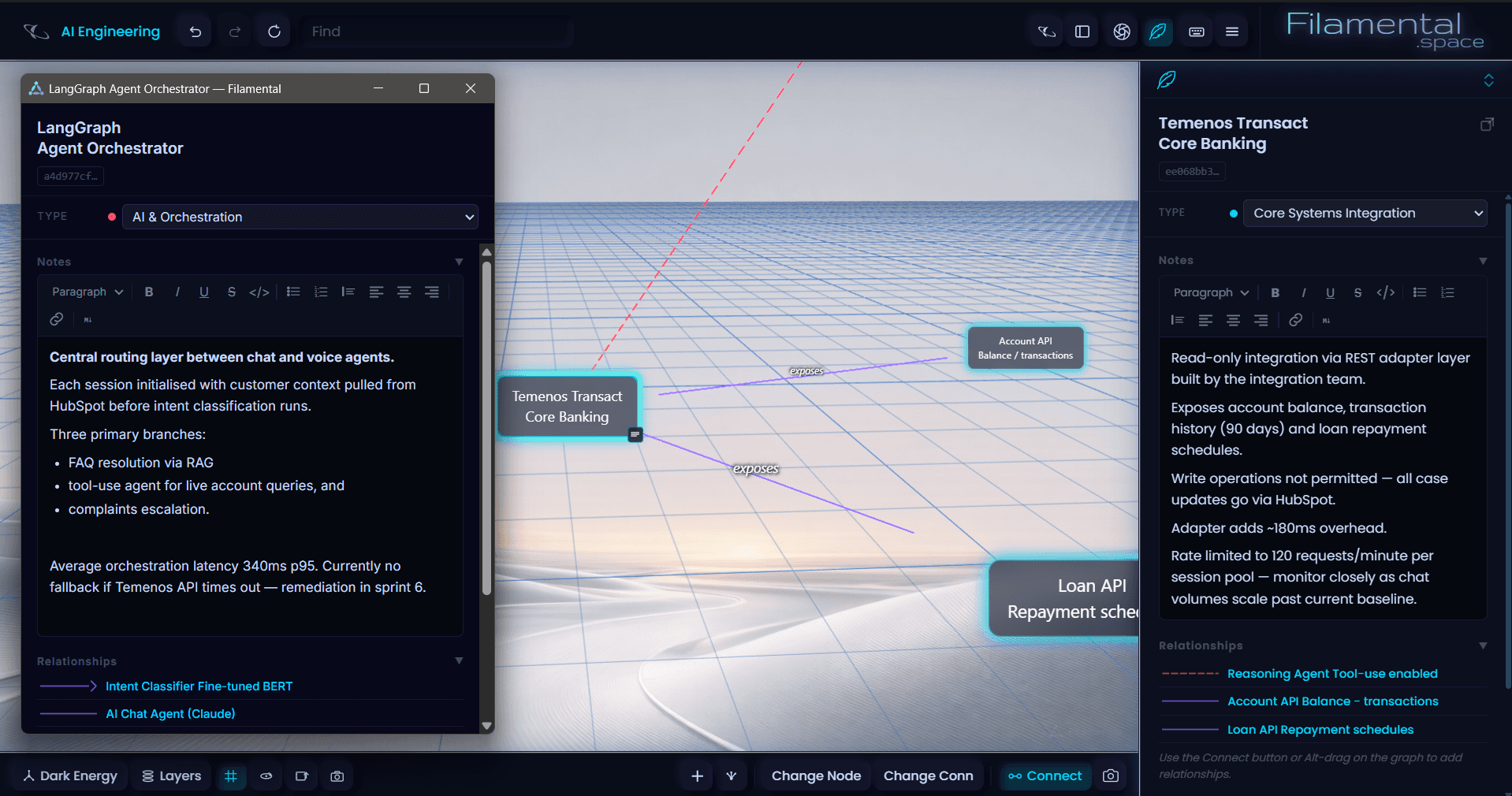
Lay out agents, tools, decision points, fallbacks. Connect what hands to what. Adjust the structure as your understanding changes.
The work is fluid because the medium is fluid. Hand the finished design to whoever builds it.
Write the prompts in context
Each agent or step is a node, and each node is a working document. Write the prompts there, alongside the structure they live inside.
Update them as the design evolves. Keep them where they belong, with the system they serve.
Brief the people who need to understand
Work with others.
The same World is documentation for the engineer who builds it, briefing for the stakeholder who funds it, and handover for the team who inherits it.
One artefact. Different views. Always current.
The format is the integration
Filamental does not have an AI feature. It doesn't need one.
What you do and draw is already the format AI assistants read natively. The system you design in Filamental is the system Claude or any other assistant understands when you point them at the folder.
We call this 'incidental integration'.
Your work speaks for itself… and understands the response.

From structure to digital twin (aka where we're going)
A well-built Filamental project is more than documentation. It is a model of how your organisation actually functions. The processes, the decisions, the dependencies, the people, the systems.
As you build this out, something happens. The structure becomes rich enough that an AI assistant can navigate it, can propose changes, can simulate outcomes and can answer questions about the organisation that previously required a human with years of institutional memory.
You have not just documented your work. You have built a control surface for the business itself.
This is the foundation of the AI department. Not a team that buys subscriptions and calls itself AI-enabled. A team that can see the organisation clearly enough to direct intelligence through it. To tweak a variable in Filamental and watch the change propagate through the system via the AI tools connected to it.
You now run the company.
The future belongs to the engineers who can explain and show their work. Who can hand an AI a map of the business and say: operate from this. Filamental is where that map lives.
Filamental is where that explanation lives.